

Also read: Cathay Pacific Business Class Review (777-300ER) FRA to HKG: Is the Old Seat Still Worth It? — the long-haul leg of the same trip.
Watch the full review on YouTube and subscribe to our channel!
In This Cathay Pacific Regional Business Class Review
Cathay Pacific’s regional business class on the HKG–KIX route blends excellent lounge access at HKG’s The Pier with solid inflight service, but the ageing 2-3-2 seat on the 777-300 lacks direct aisle access and the IFE screen is small. Best booked as a connecting leg on a long-haul itinerary, not as a standalone purchase.
Quick Verdict: Is Cathay Pacific Regional Business Class Worth It on HKG–KIX?
Short answer: Yes, but only if you book it as a connecting leg from a long-haul Cathay business class ticket. As a standalone, the regional premium is hard to justify.
Low-cost carriers like Hong Kong Express and Peach get you to Osaka in similar time for a fraction of the price. As a connecting leg on the same ticket, you get lounge access at HKG (The Pier alone is worth the upgrade), priority everything, and a more comfortable seat than economy, which adds up over a multi-stop trip.
The honest trade-off: The 2-3-2 configuration on the 777-300 is showing its age. The seat is fine for a daytime three-and-a-half-hour hop, but it’s not the same product as the long-haul 777-300ER.
The headphone jack is non-standard (3.5mm + 2.5mm), the in-flight entertainment screen is small, and the seat doesn’t have direct aisle access for everyone. If you can stretch your budget to first class or wait for the new Aria Suite, do that. Otherwise, regional business class is a solid tier above economy and a comfortable way to spend a half-day in the air.
Key Takeaways
- Flight: Cathay Pacific CX506, Boeing 777-300, HKG → KIX, ~3h 30min
- Seat: 2-3-2 regional business class configuration (older product vs. the long-haul 777-300ER’s 1-2-1 reverse herringbone)
- Best for: Travellers connecting from a long-haul Cathay flight, or anyone who values lounge access at HKG over saving money on a low-cost carrier
- Highlight: The Pier lounge at HKG: A real bucket-list Cathay lounge with a strong Hong Kong food spread
- Skip if: You’re booking this flight on its own and want the cheapest way to get to Osaka
Quick Flight Info
Here’s a snapshot of the flight covered in this review:
- HKG → KIX (Osaka)
- Airline / Flight Number: Cathay Pacific / CX506
- Date: Saturday, 14 December 2024 (continuation of trip)
- Departure: 10:45 (HKT) from Hong Kong International Airport (HKG)
- Arrival: 15:15 (JST) at Kansai International Airport (KIX)
- Aircraft: Boeing 777-300
- Cabin: Business Class (Regional)
- Effective Flight Time: 3h 30min
The HKG–KIX route spans approximately 2,500 kilometres with a flight time of about 3.5 hours, making it one of Cathay Pacific’s shorter regional business class routes.
Getting to HKG and Check-In
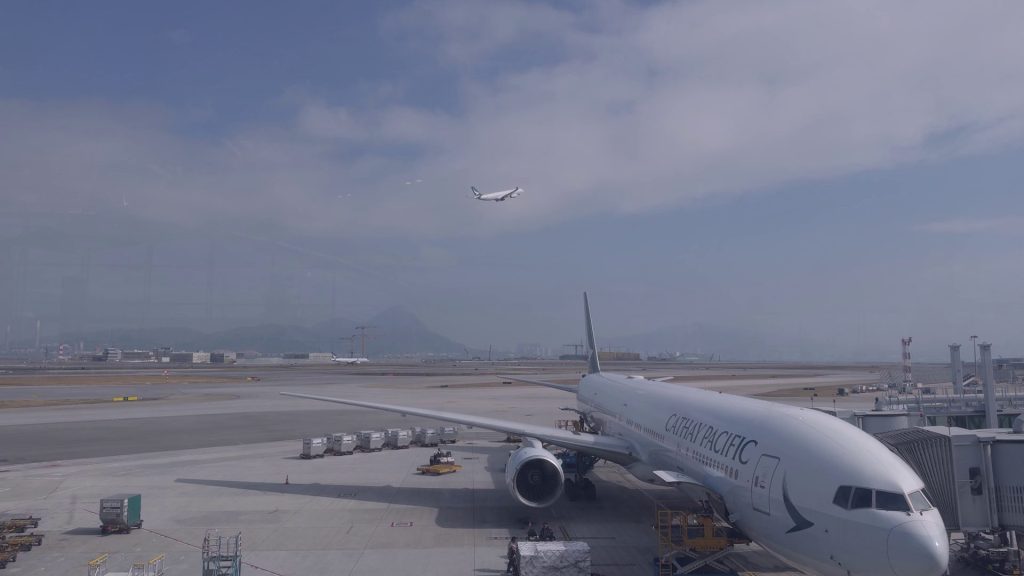
We pick up where we left off in the last report, at The Murray Hotel in Hong Kong. After a somewhat hasty breakfast, we take a taxi to Hong Kong Station and catch the Airport Express to Hong Kong International Airport. The ride is quick, and the connection between train and terminal is one of the smoothest you’ll find in Asia.
Since this is Cathay’s home terminal, there are more than enough desks to check in, particularly for business class passengers. The business class counters are all the way to the left in section B. The signage is clear, the staff are attentive, and the whole process is over in a matter of minutes.
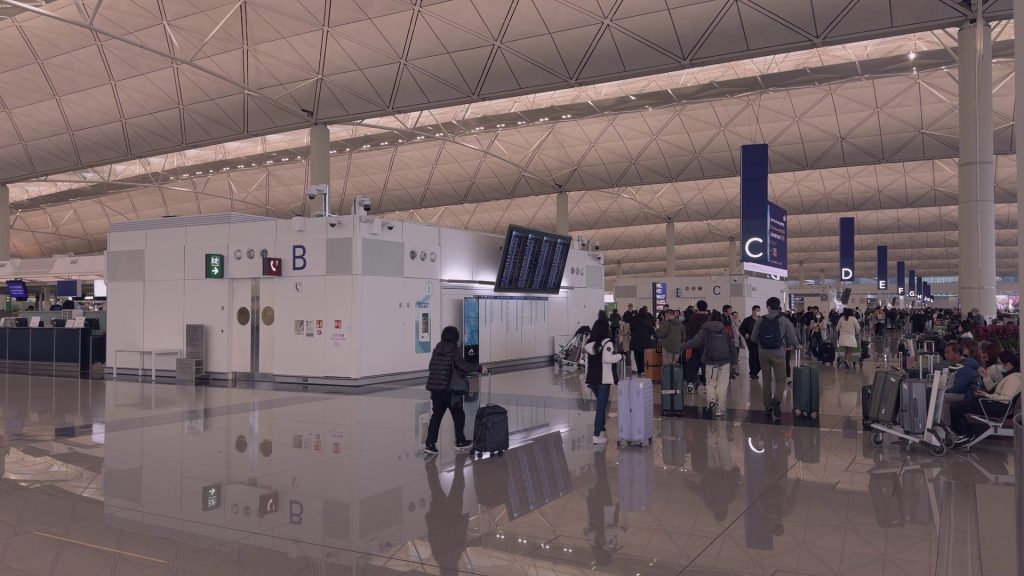
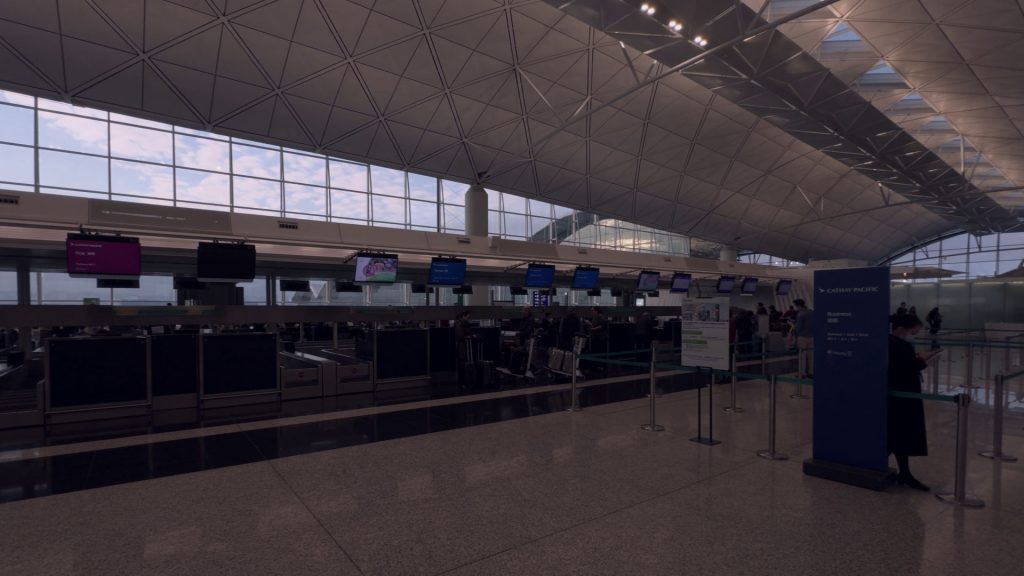
Tip: The business class check-in is in section B, all the way to the left. Even if you don’t see obvious signage, walking towards that end of the terminal will get you there quickly.
Security and Immigration at HKG
After a smooth check-in experience, we proceed to immigration and security. Conveniently, the electronic displays show the current queueing status, which is quite long on this Saturday morning. In the end, it takes us around 35 minutes from check-in to the lounge. Not terrible, but worth factoring in if you have a tight connection or are flying out of HKG on a weekend morning.
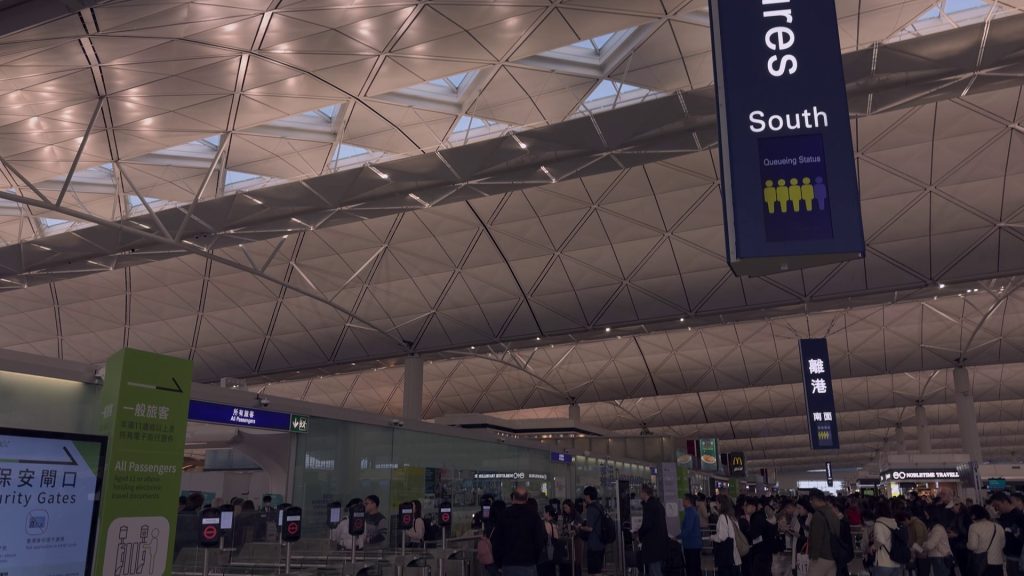
If you’re connecting through Hong Kong from another flight, expect similar or even longer queues on weekend mornings. HKG handles huge volumes of regional and long-haul traffic, and immigration can quickly become the bottleneck of your trip. The good news is that the staff keep the lines moving, and the digital displays help you plan your time rather than guess.
Cathay Business Lounges at HKG
Business class passengers have complimentary access to three Cathay Pacific lounges at Hong Kong International Airport, all located in Terminal 1:
- The Pier — the lounge we visited on this trip
- The Wing
- The Bridge
You can also find The Deck lounge, but it’s exclusive to first-class passengers.
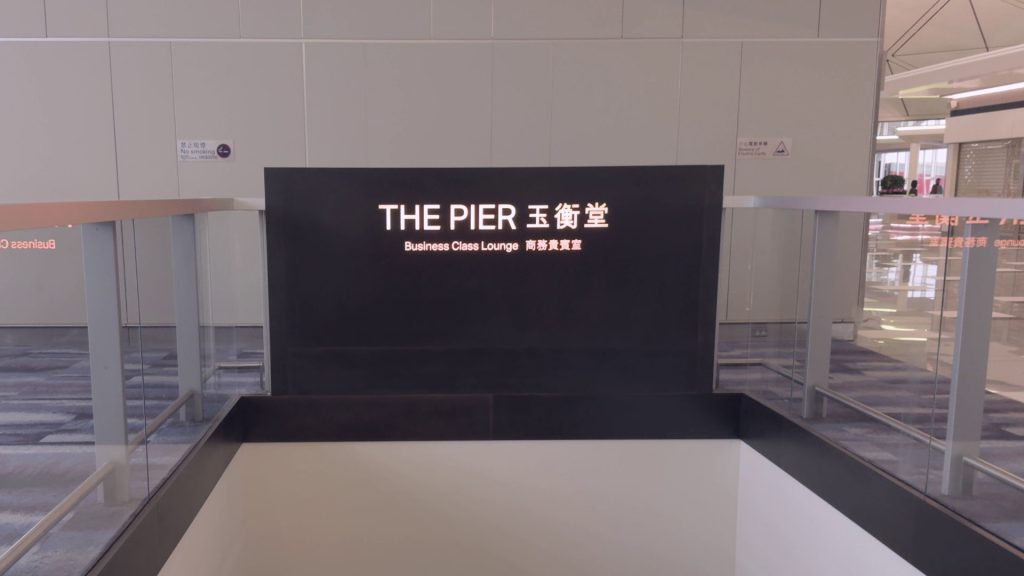
During check-in, you’ll most likely be told which lounge is closest to your departure gate, but you’re free to visit whichever one you prefer. Each lounge has its own character and crowd. We chose The Pier for this trip, and it turned out to be a real highlight of the journey.
Cathay Pacific The Pier Lounge at HKG
Cathay’s business class lounges are often either beloved or hated, and reactions tend to depend on which one you visit and when. We count ourselves firmly in the camp that loves The Pier. It’s been on my personal aviation bucket list for a while, and I was genuinely glad we managed to integrate it into the travel plans.
Aesthetic
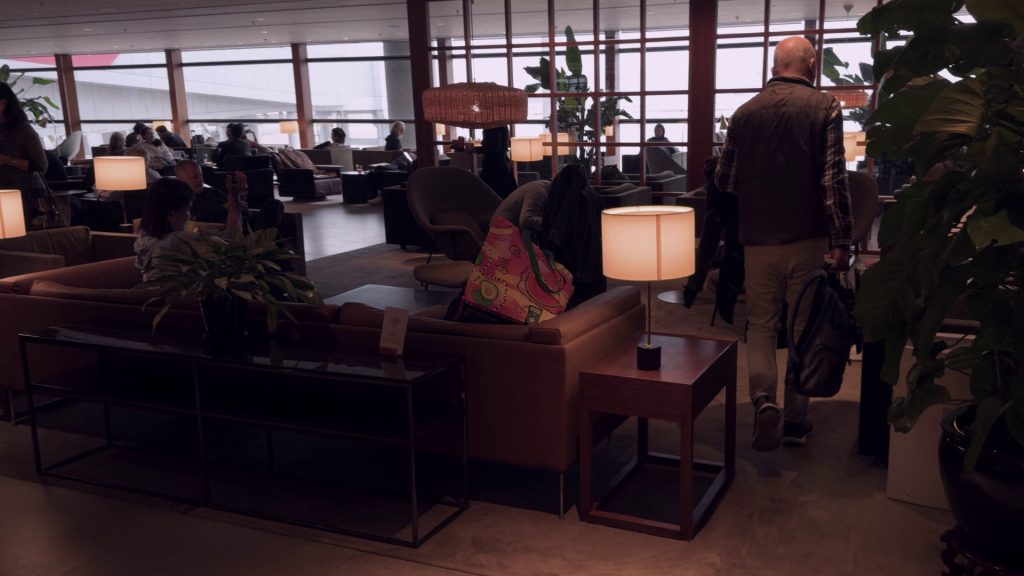
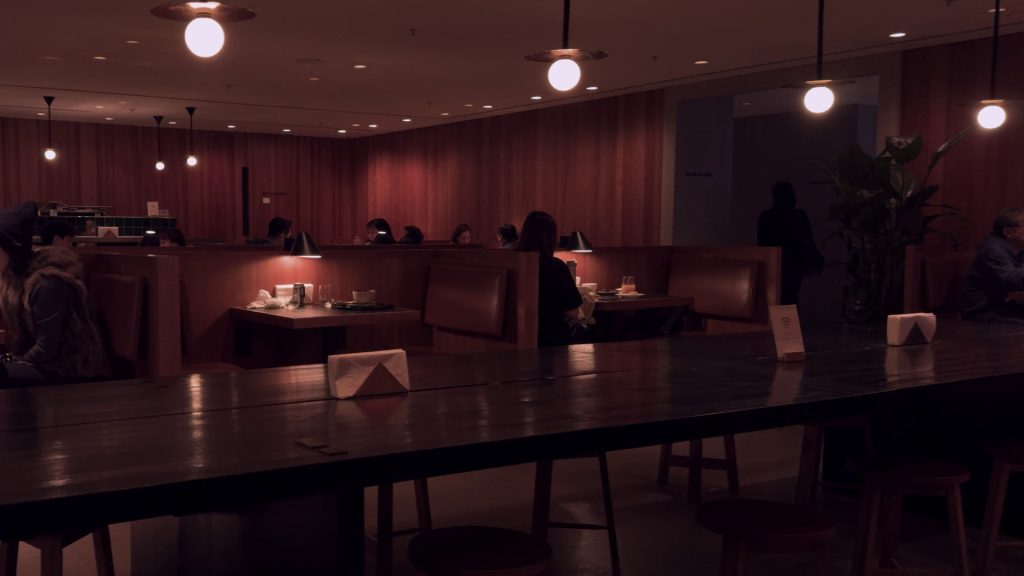
The lounge comes in a typical Hong Kong aesthetic: Dark, muted colours, tiled surfaces, and an atmosphere that still feels connected to the city outside. Of course, you’re still aware that you’re in an airport, but it doesn’t feel like any other generic airport lounge.
Perhaps the greatest downside is that the lounge can become quite busy and crowded. But maybe that also adds to the Hong Kong feel.
Food
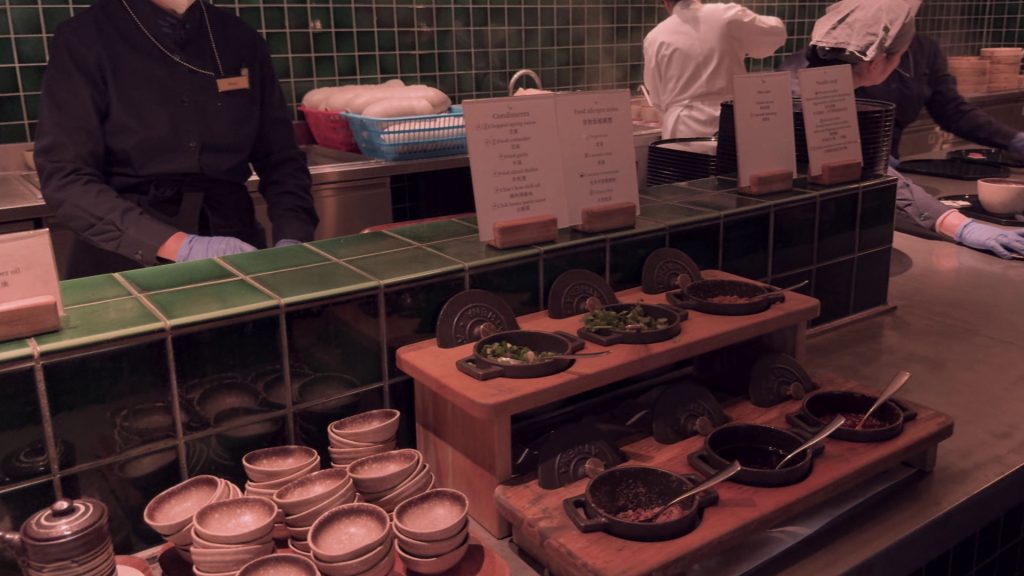
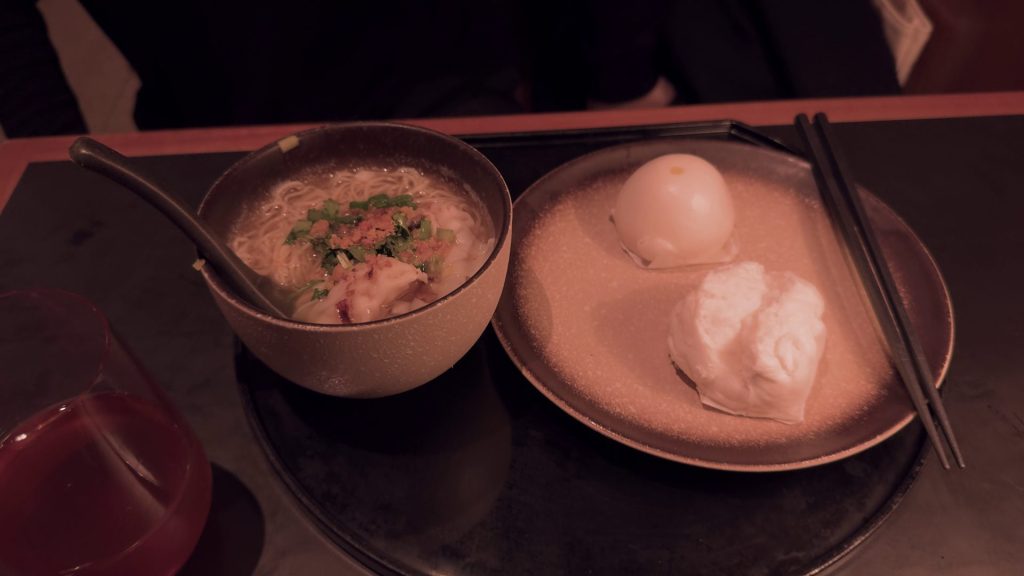
One of the best features of the lounge is its blend of Hong Kong cuisine and international dishes. The selection is pretty extensive for a business lounge, and it goes well beyond the usual cold buffet that you find in most airport lounges.
Local dishes sit alongside Western options, and the quality is consistent with what you’d expect from a Hong Kong hotel breakfast spread.

Bar and Tea House
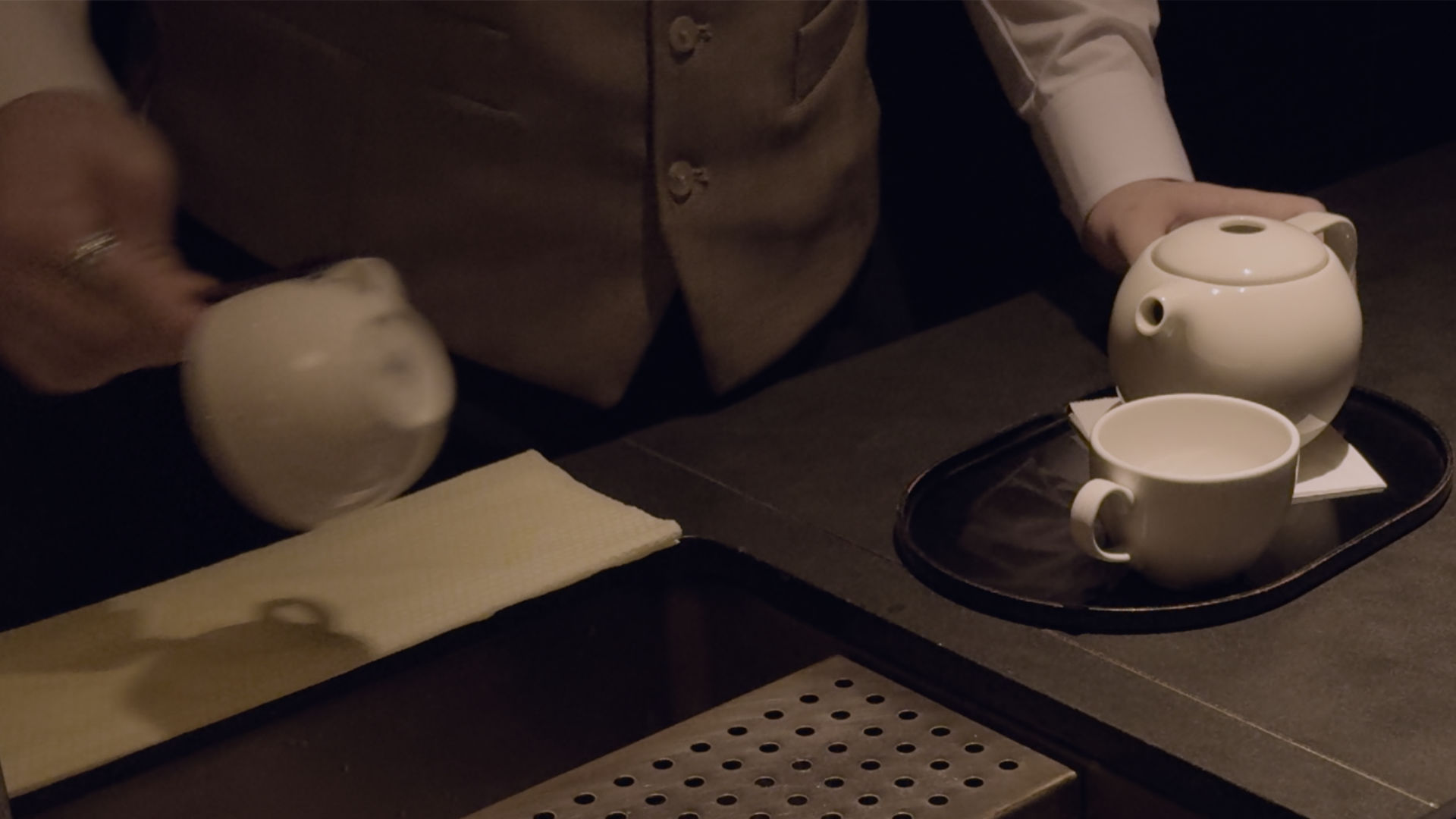
The food offering is made even better by the additional stylish bar and tea-house area. I think what makes this so great is that it still feels like part of the city and its charm. The tea house, in particular, is a nod to Hong Kong’s tea culture and a feature I’ve rarely seen in other airline lounges.
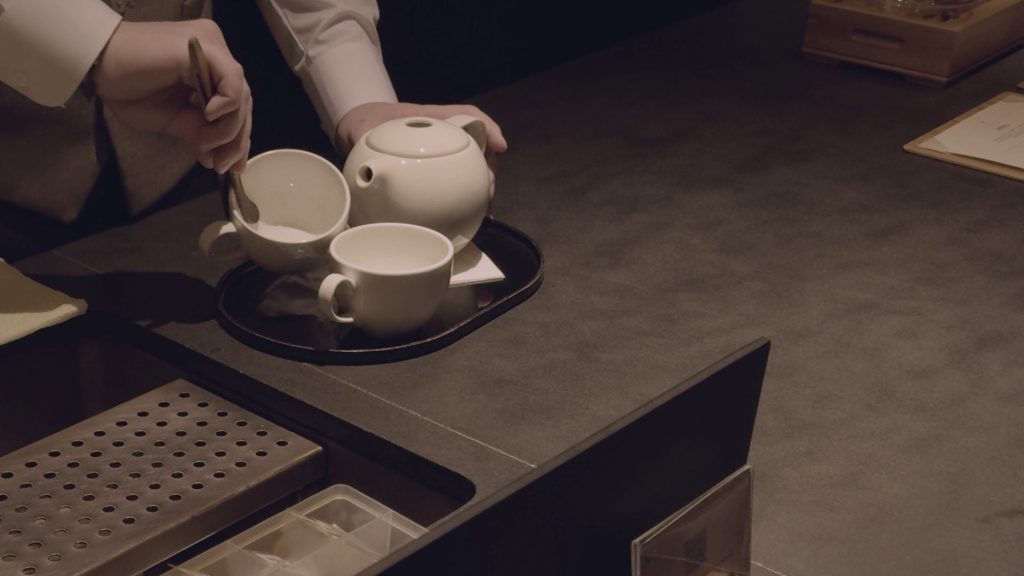
Tip: The Pier can become quite busy and crowded, especially on weekends and during peak morning departures. If you have time, get there early to grab a quieter seat. The tea-house area is usually less crowded than the main dining space, and it’s a great spot to relax before a flight.
On its own, The Pier makes the case for booking a business-class ticket on a regional Cathay flight. Even if the seat onboard doesn’t move the needle for you, lounge access at HKG is one of the best business-class perks in Asia.
Gate 66 and Boarding
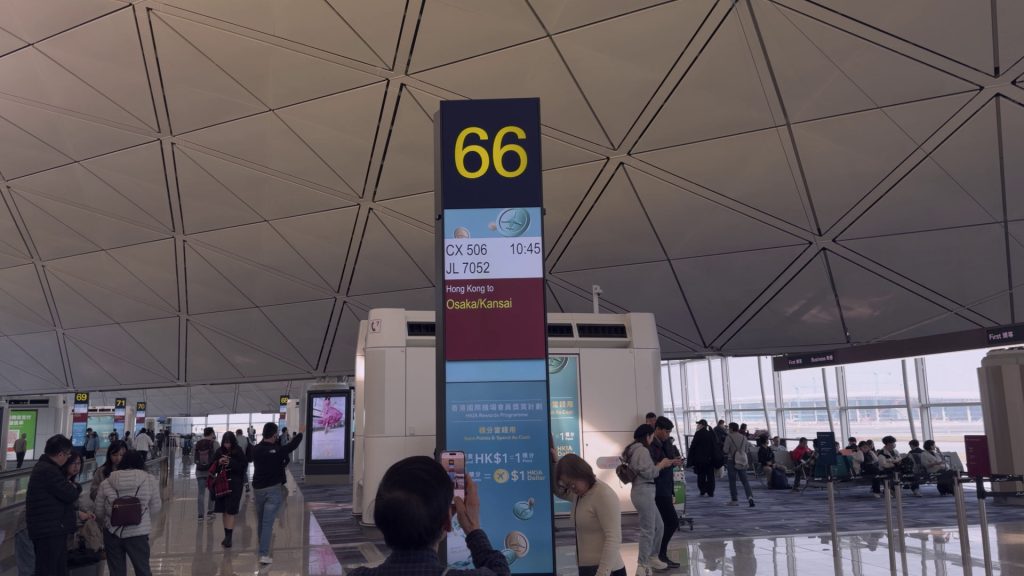
From the lounge, we head to Gate 66 for flight CX506 to Kansai International Airport. Boarding this almost-full flight goes well, aside from some waiting on the jet bridge. The process is standard for a wide-body departure, with multiple boarding groups called in succession.
Cathay Pacific 777-300 Business Class Seatmap (2-3-2 Configuration)
For this flight, we’re seated all the way in the back of business class in row 18. For shorter regional routes like this one, Cathay is using a rather old board product with a 2-3-2 configuration.
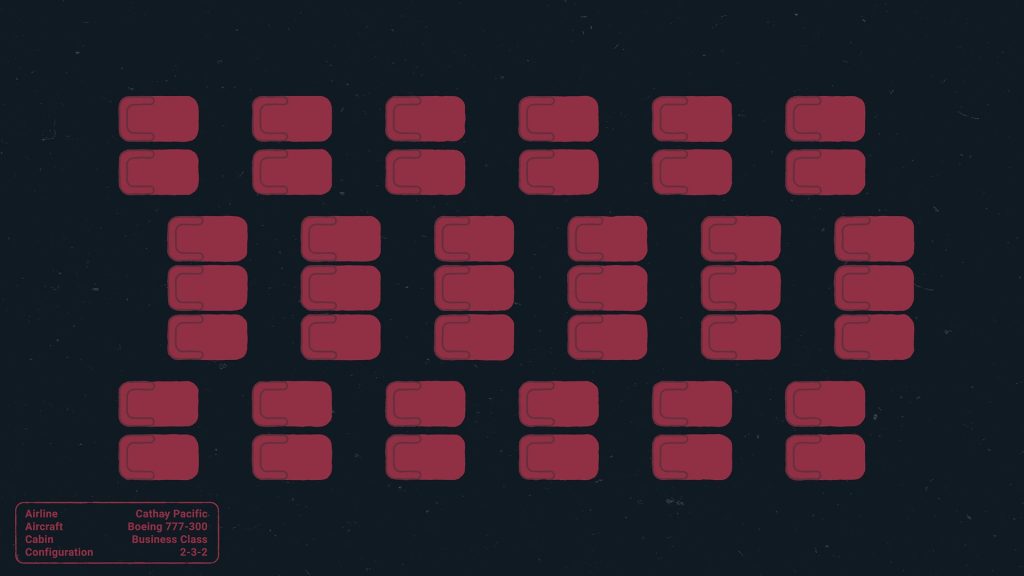
You can usually see this in the type of aircraft. On long-haul flights, Cathay often uses the Boeing 777-300ER, where you get the newer 1-2-1 reverse herringbone layout with direct aisle access for everyone. On shorter regional flights like this one, they’re more likely to deploy the older Boeing 777-300 with the 2-3-2 arrangement.
Tip: If you’re booking a regional flight with Cathay, always check the aircraft type before you book. The 777-300ER typically means the newer, fully flat product. The 777-300 means this older 2-3-2 configuration — still comfortable for a daytime flight, but a very different experience, and not great for solo travellers who end up in a middle seat.
Admittedly, the seat is more than fine for a daytime three-and-a-half-hour flight. The seat pitch is generous, there’s solid power at each seat, and the legroom is comfortable. It’s just not the same product you’d get on long-haul routes, and on a red-eye or overnight sector, this recliner seat would likely feel underwhelming compared to a lie-flat seat.
The Seat
Stepping into the cabin, the first thing that strikes me is that it has the same dark, almost moody tones with subtle deep red accents as the long-haul 777-300ER, very much in line with the Hong Kong aesthetic we saw in the lounge. It’s less of a polished luxury look and more of a grounded elegance.
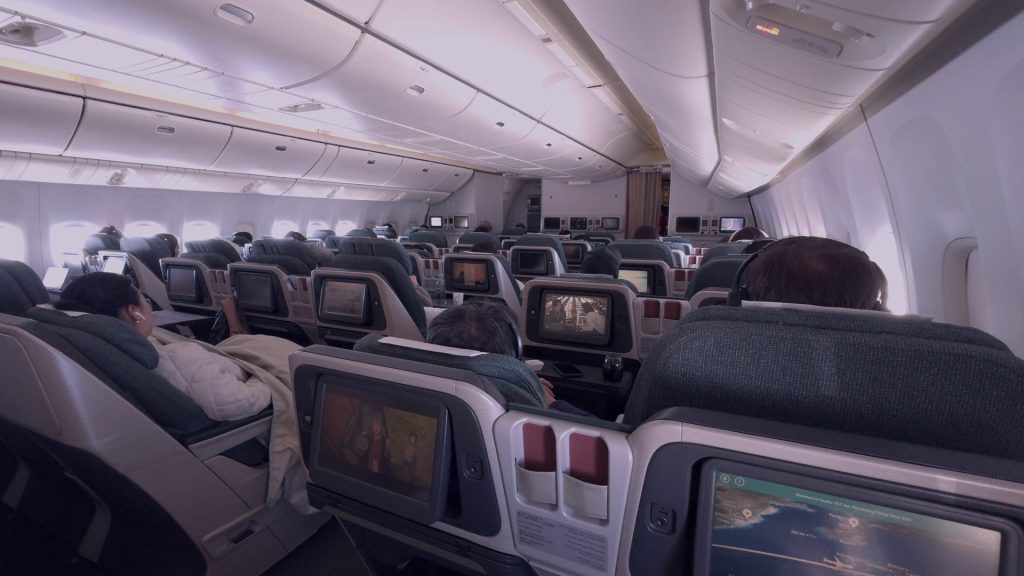
The seat itself reclines to a generous angle and offers ample personal space and storage for a daytime flight. It’s clearly an older-generation product compared to the 1-2-1 layout on the 777-300ER, but it has its own charm.
The materials feel a little less refined than the long-haul seat, and the surfaces show their age, but for a three-and-a-half-hour hop during the day, it’s perfectly serviceable.
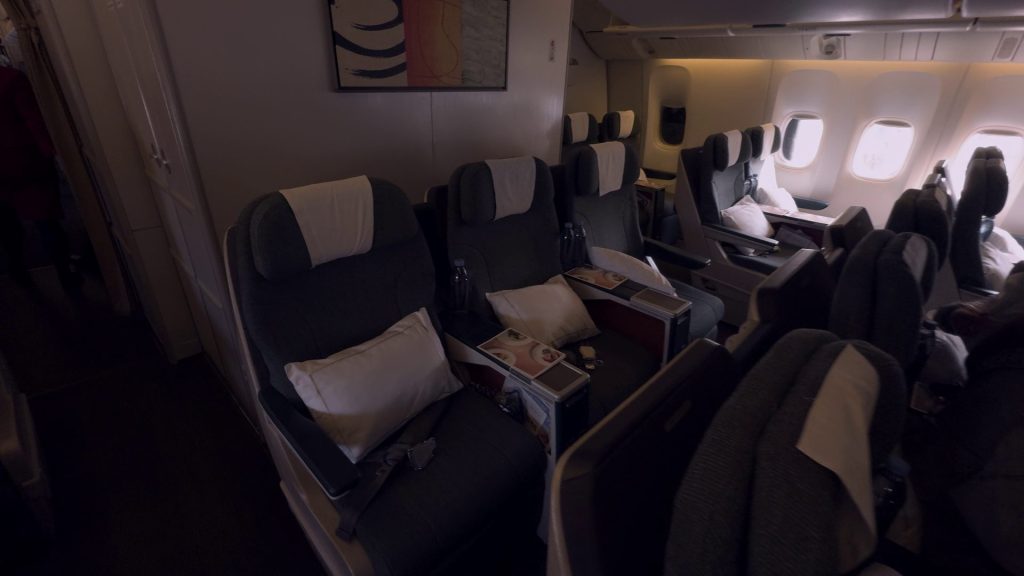
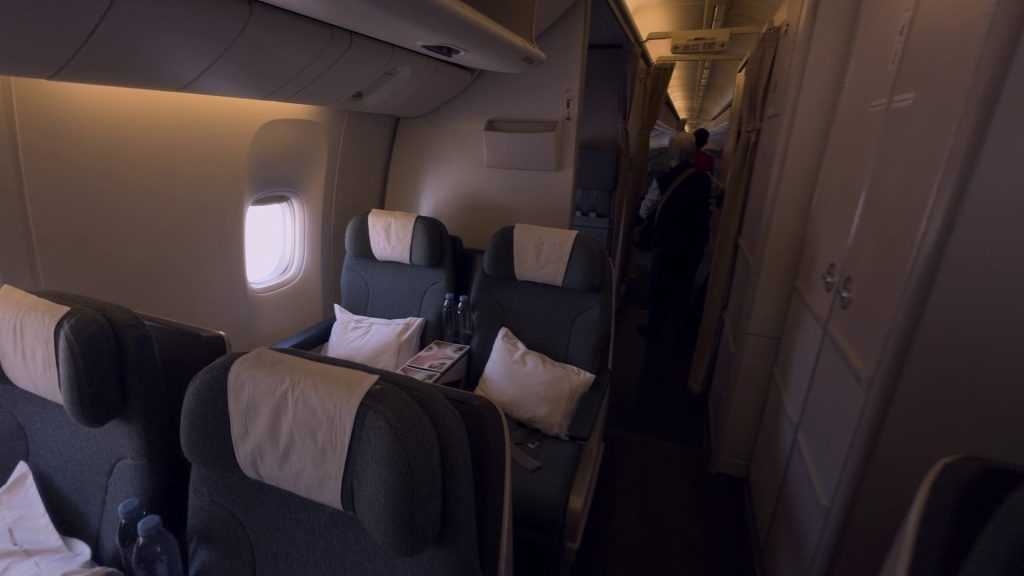
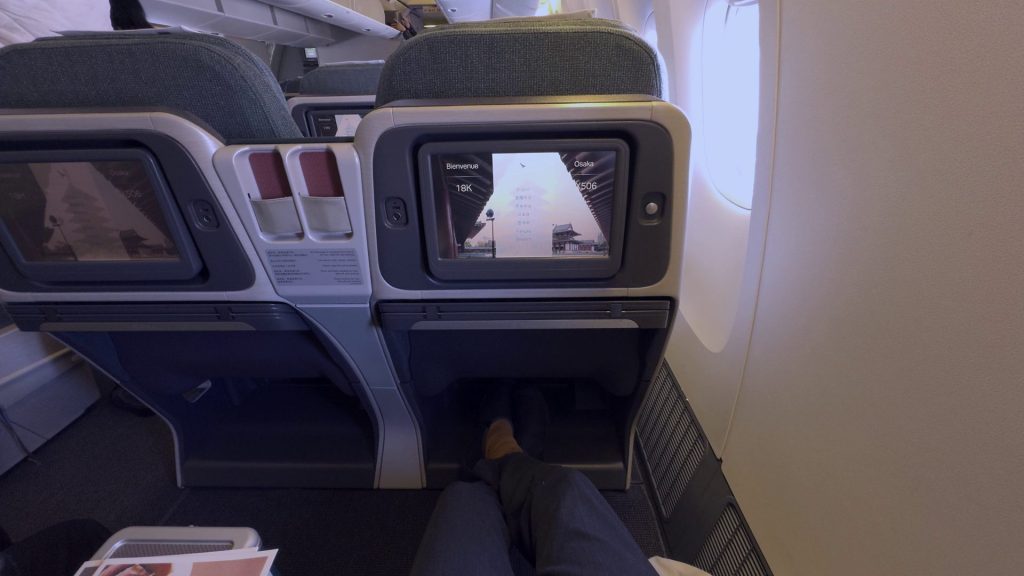
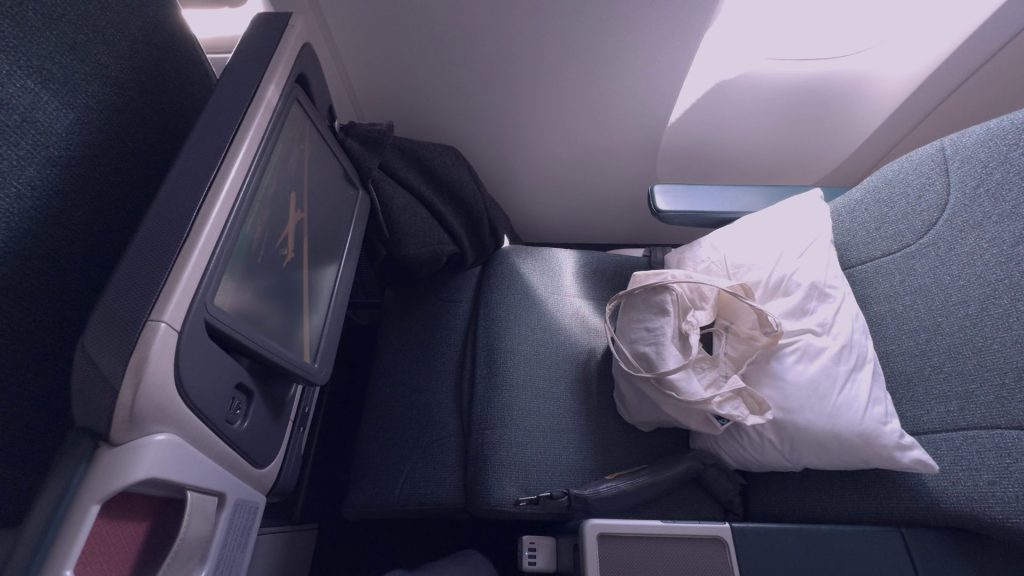
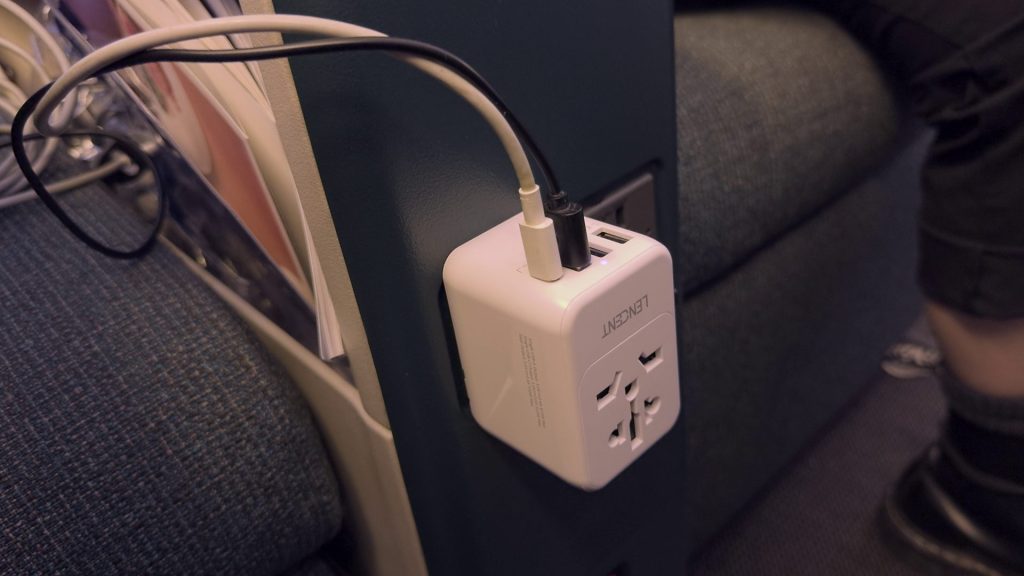
Tip: When booking a window seat in a 2-3-2 layout, you’ll either get a single seat (A or K) or a paired window seat (B or J). The single seats are noticeably more private and a better pick for solo travellers.
Headphones, Headphone Jack, and In-Flight Entertainment (IFE)
The screen on this older product is not large, but fine for a three-and-a-half-hour flight. The user interface is the same Cathay Studio system found on the long-haul fleet, with a broad selection of films, series, documentaries, and regional programming. You can also mark items as favourites while browsing, making it easier to queue content later without scrolling through the full catalogue.
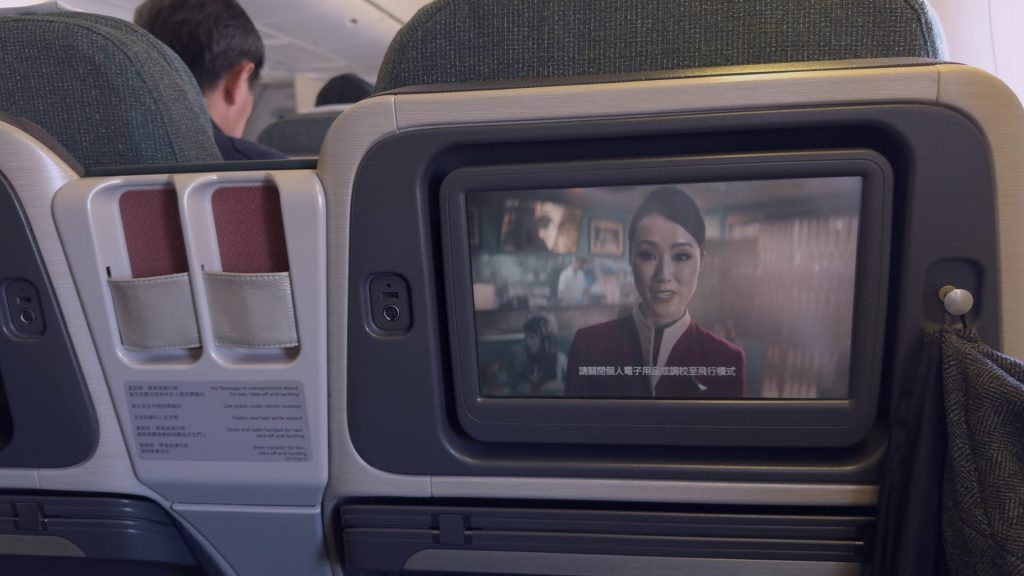
Somewhat annoyingly, however, the headphone jack is not the usual 3.5mm double-pin you’ll find on most long-haul aircraft, but a mix of 3.5 and 2.5mm audio jacks. That means the Bluetooth headphone adapter I mentioned in the last review (AliExpress) doesn’t fit here either. The on-board headphones are a bit too plasticky for my taste, so I end up connecting my own earbuds to my phone instead and using them for entertainment.
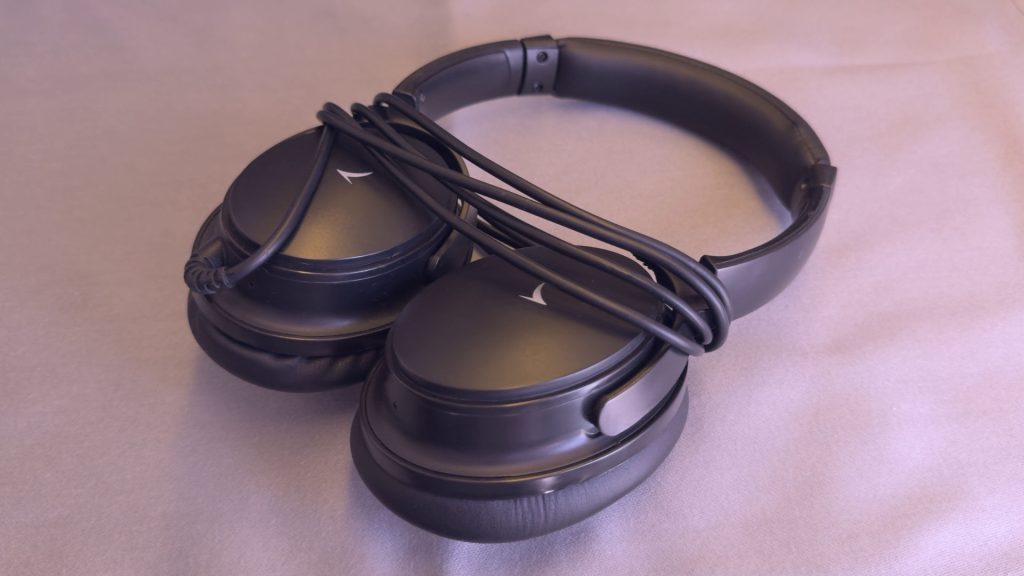
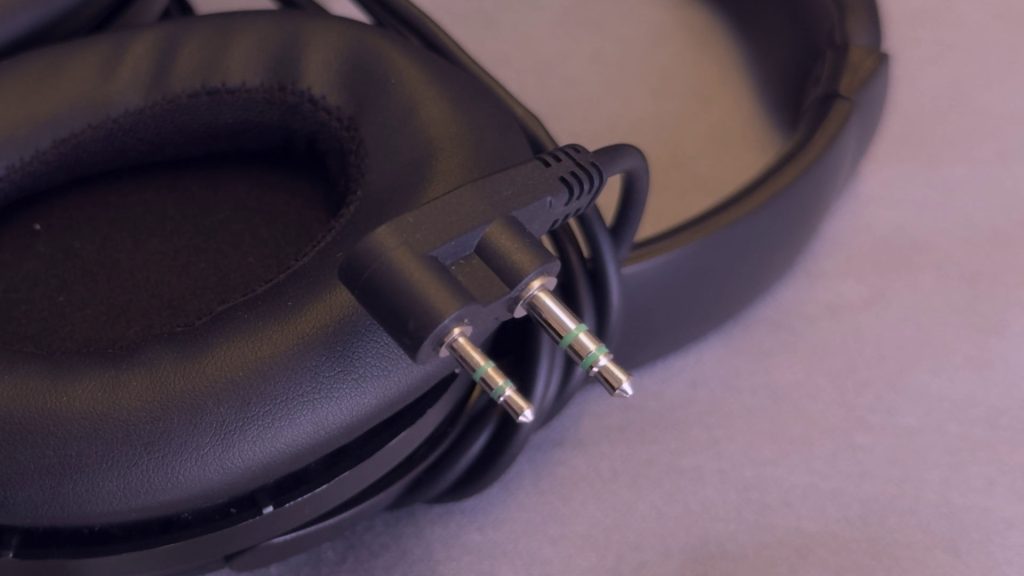
Tip: On regional Cathay flights with the 777-300, the non-standard headphone jack makes the on-board IFE awkward unless you’re fine with the provided headphones. Bring your own earbuds and plan to use your phone or tablet for entertainment. The seat has reliable power, so this isn’t a real problem, just a small planning point.
In-Flight Service (Lunch)
The main thing that makes this a premium experience is the service. The menu is not too large, but it offers a nice selection of Hong Kong and Japanese dishes, especially given the short flight and the fact that we had already had breakfast at the hotel and brunch in the lounge.
They also serve their signature Cathay Delight (a coconut-and-kiwi mocktail) and a range of spirits and teas.
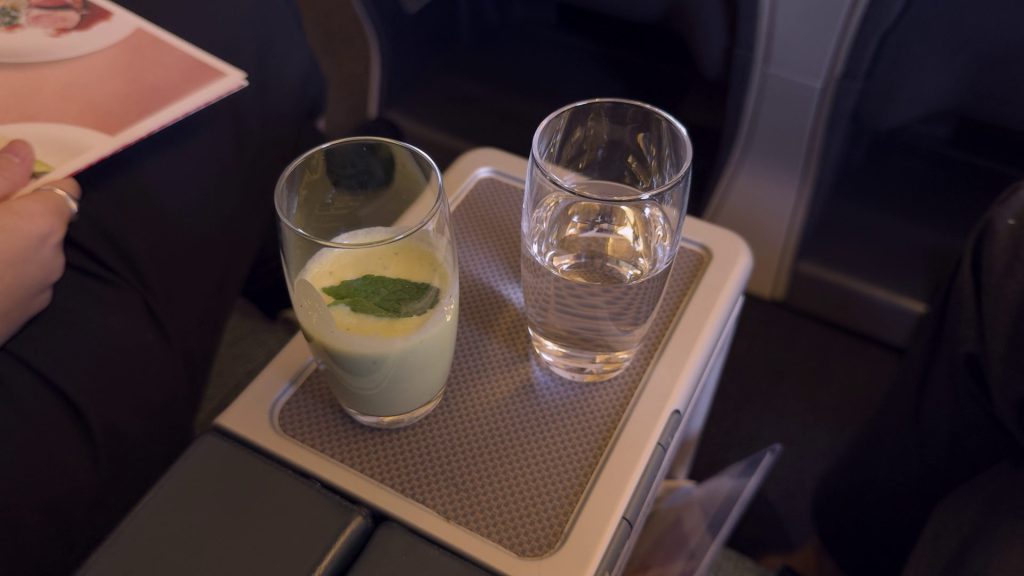
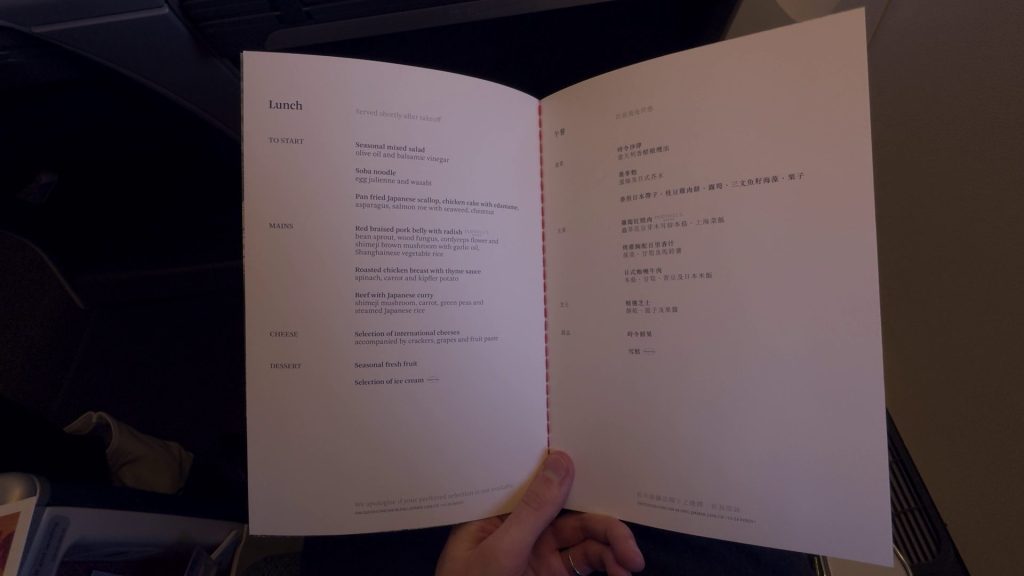
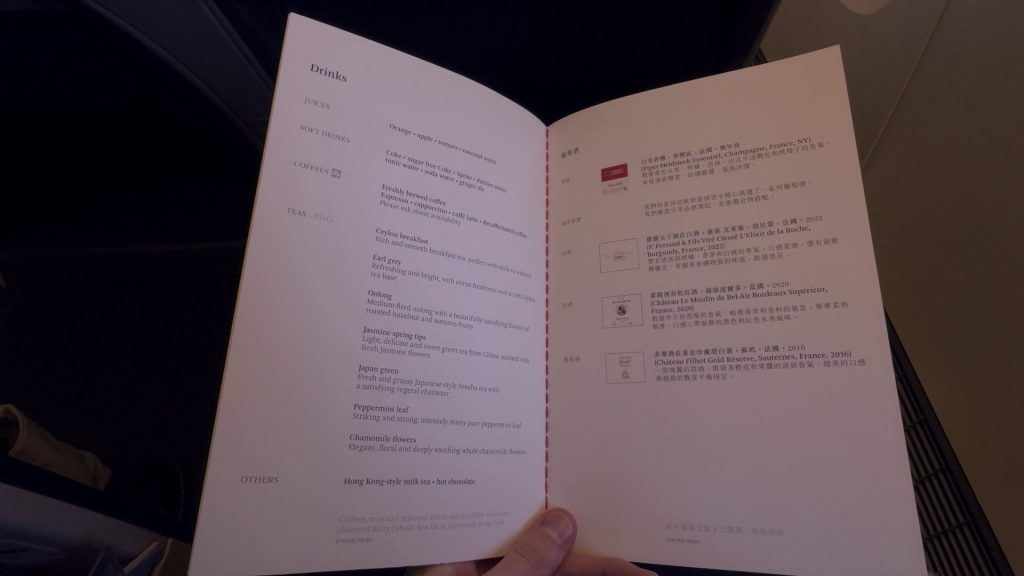
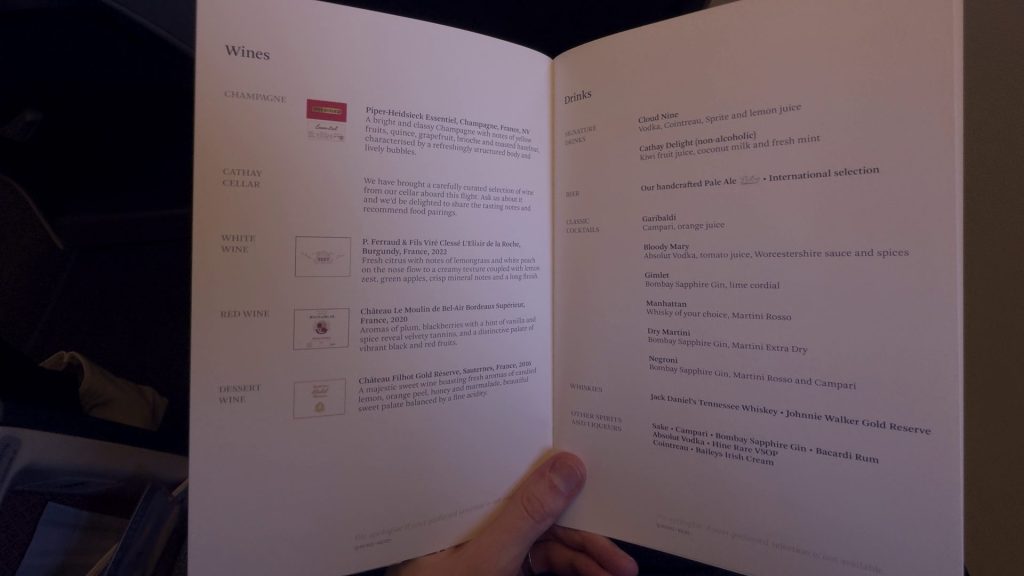
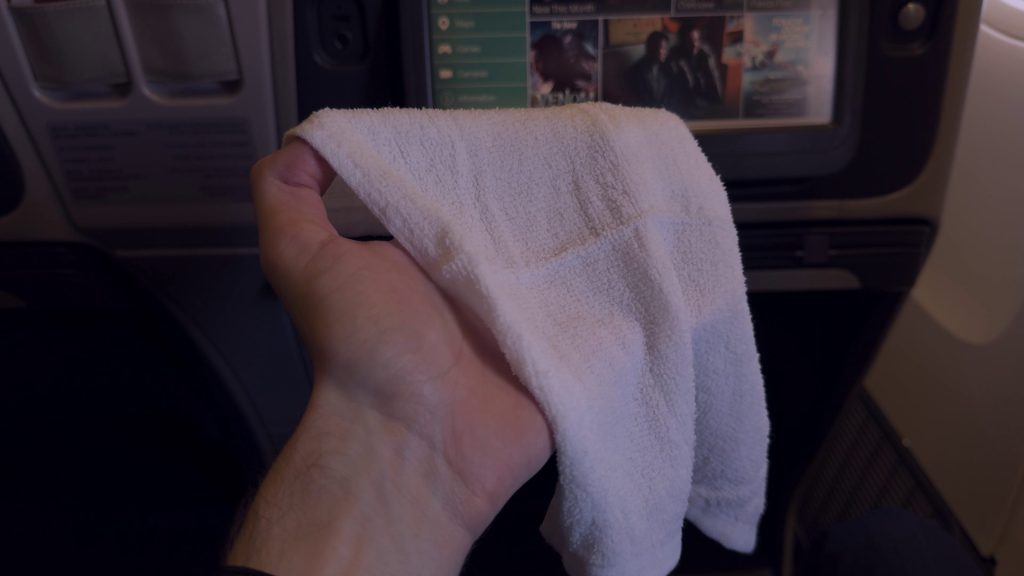
The service starts with a hot towel, a small but appreciated detail that not every regional business class service still offers post-pandemic.
About 30 minutes after takeoff, the appetisers are served. Here you can see the braised chicken and pork belly dishes, which are neither outstanding nor absolutely fine. Both dishes are presented on proper tableware, which is a small touch that still feels special on a regional flight.
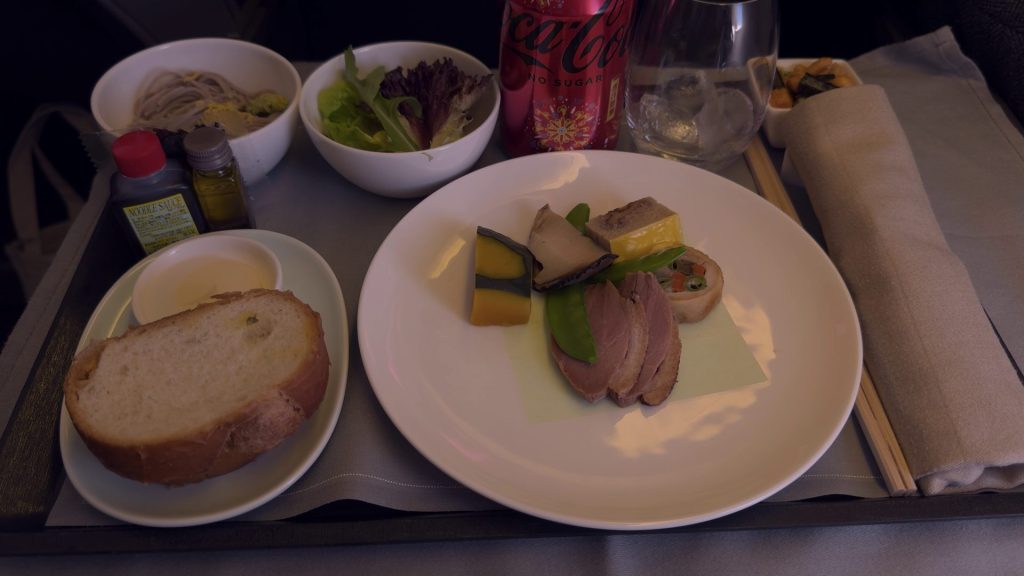
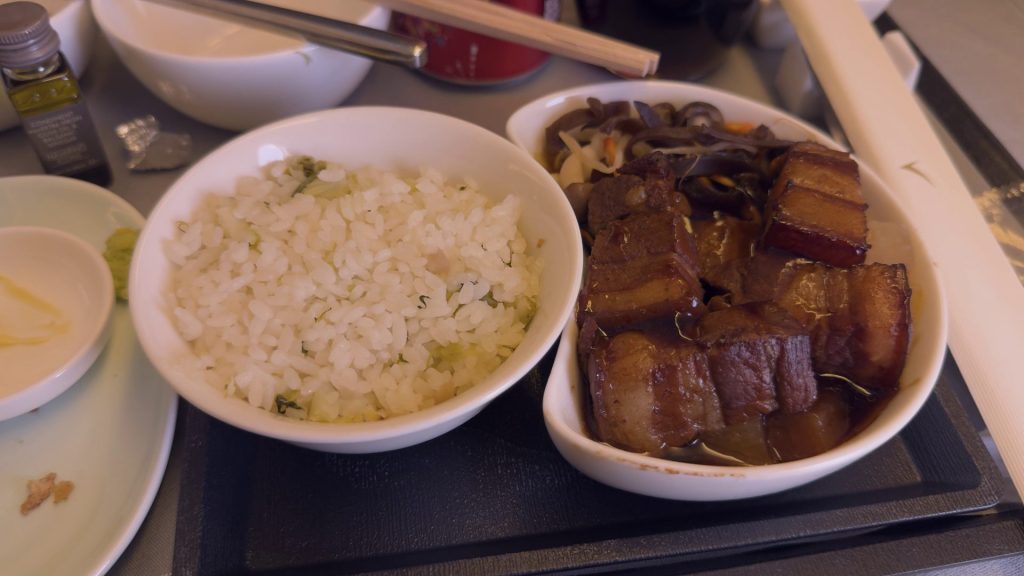
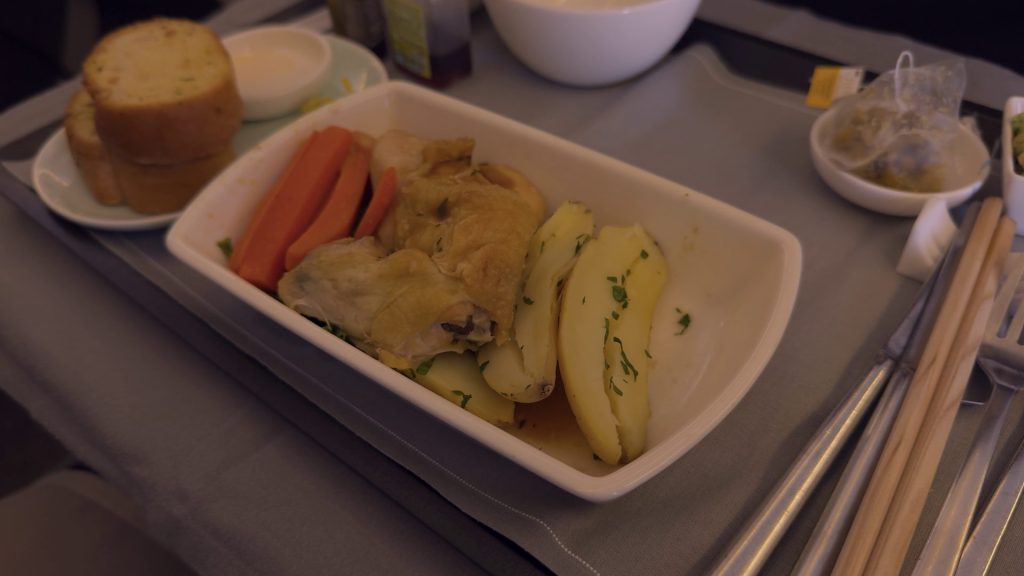
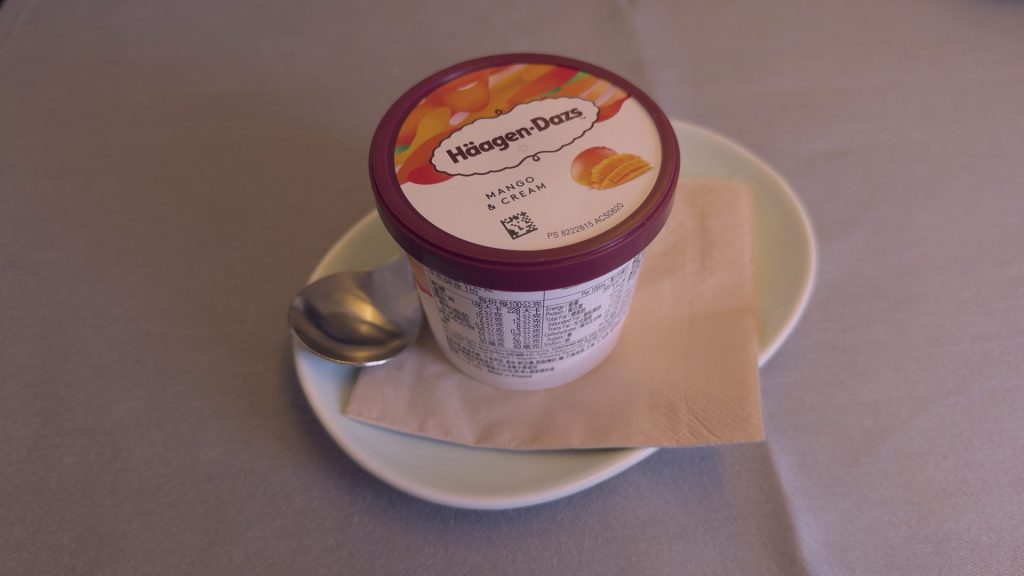
The lunch is finished with ice cream and wraps up about one-and-a-half hours after takeoff, so roughly halfway through the flight. After that, the rest of the trip is mostly a matter of waiting for the descent into Osaka.
Lavatory
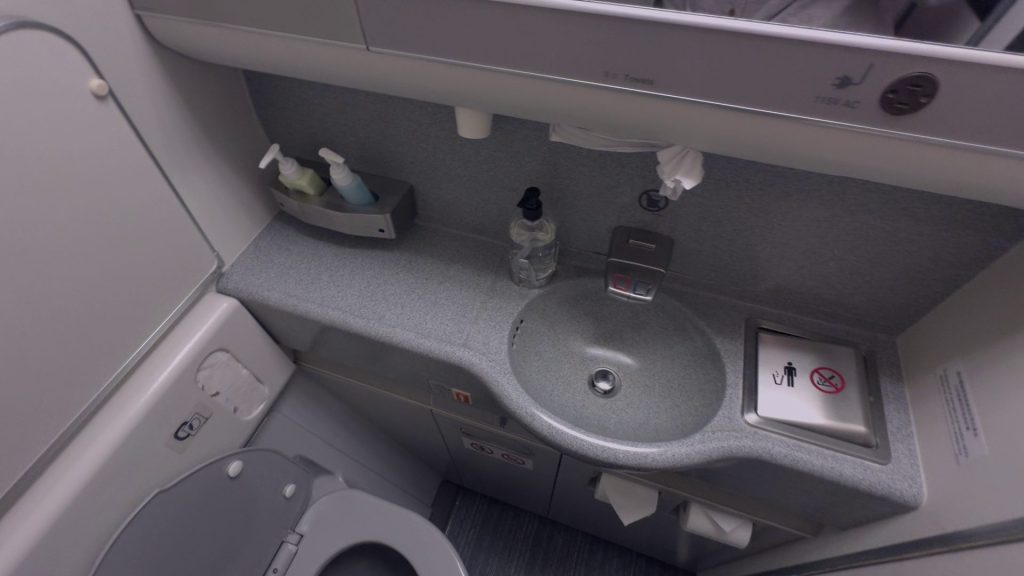
There is not much left to do for the rest of the flight, but I do check the lavatories, which are totally fine. They are clean, well-stocked, and spacious enough for a regional wide-body. The business class bathrooms on the 777-300 share the same general design language as the long-haul cabins, including the same amenity layout.
Arrival at Kansai International Airport (KIX)
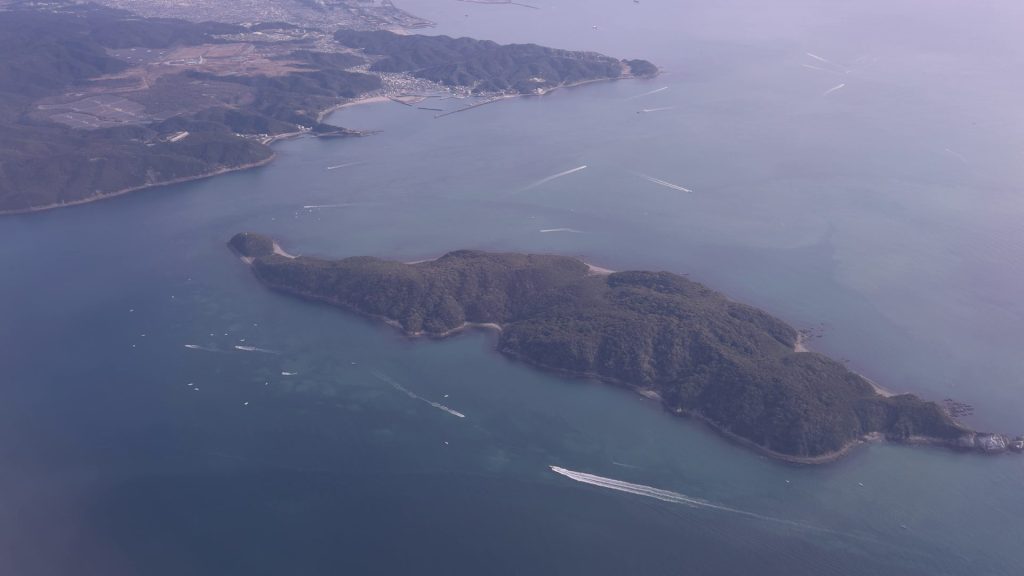
On schedule, we approach Osaka and touch down at Kansai International Airport at 3:15 pm local time. The approach over the bay is one of the more dramatic in Asia, with the airport’s artificial island clearly visible as you descend. De-boarding and immigration run smoothly, and we make our way to the airport train station.
Getting from KIX to Kyoto (Haruka Express)
Since we are going straight to Kyoto from the airport, we visit the local ticket office and purchase tickets for the Haruka Express, which directly connects Kansai International Airport to Kyoto Station. The ride takes about 75 minutes and is a comfortable, scenic way to start the Japan leg of the trip — particularly if you get a window seat; the views of the Japanese countryside as you approach Kyoto are beautiful.
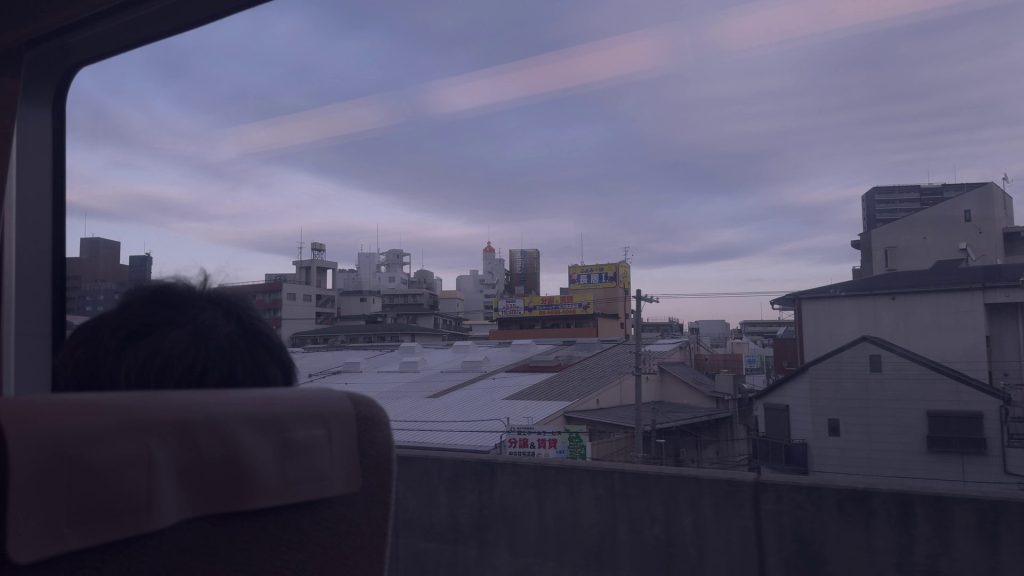
Tip: If you’re staying in Kyoto, the Haruka Express is by far the easiest way to get there from KIX. The train is comfortable, the ride is direct, and the scenery is a nice transition from airport to city. Buy tickets at the JR ticket office in the airport or online before you head down to the platform.
Stay Connected with Airalo eSIM in Hong Kong and Japan
Since we already set up our Asialink mobile data plan from Airalo back home, we are connected to the local service provider as soon as we touch down in Osaka. This means we can use the 75-minute train ride to plan our next steps in Kyoto without any hassle.
There’s no fumbling with SIM cards at the airport, no waiting in line at a SIM kiosk, and no roaming bill shock at the end of the month.
If you’re planning a similar multi-country trip across Asia, the Asialink plan gives you coverage across multiple countries, including Hong Kong, Japan, and South Korea, for a fraction of what most roaming packages would cost. You can purchase and install the eSIM in your home country, and it activates automatically the moment you land.
- Link to Airalo’s Asialink Plan: Airalo Asialink eSIM
- New Airalo customers: 15% off with code
NEWTOAIRALO15- Existing Airalo customers: 10% off with code
AIRALOESIM10

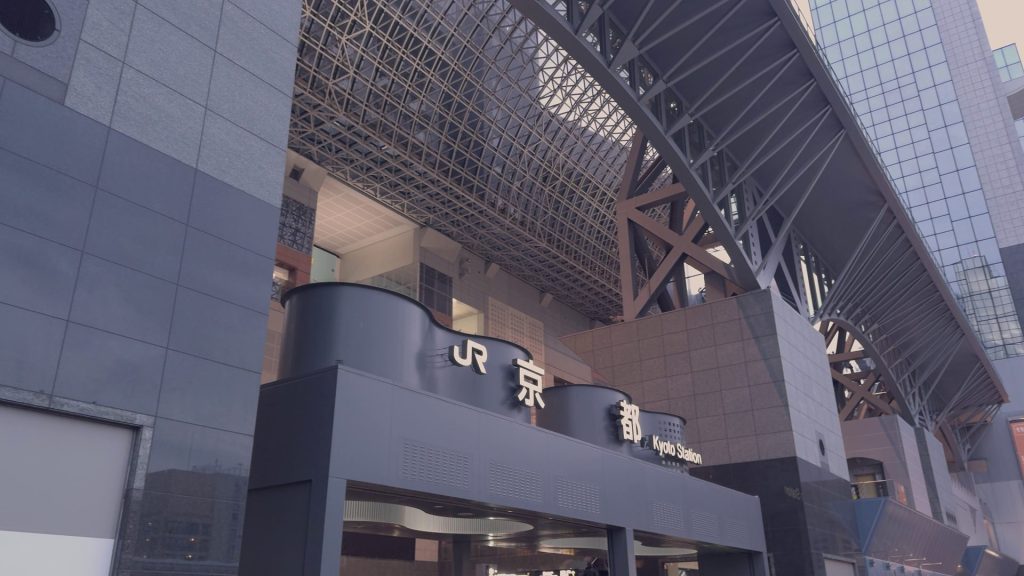
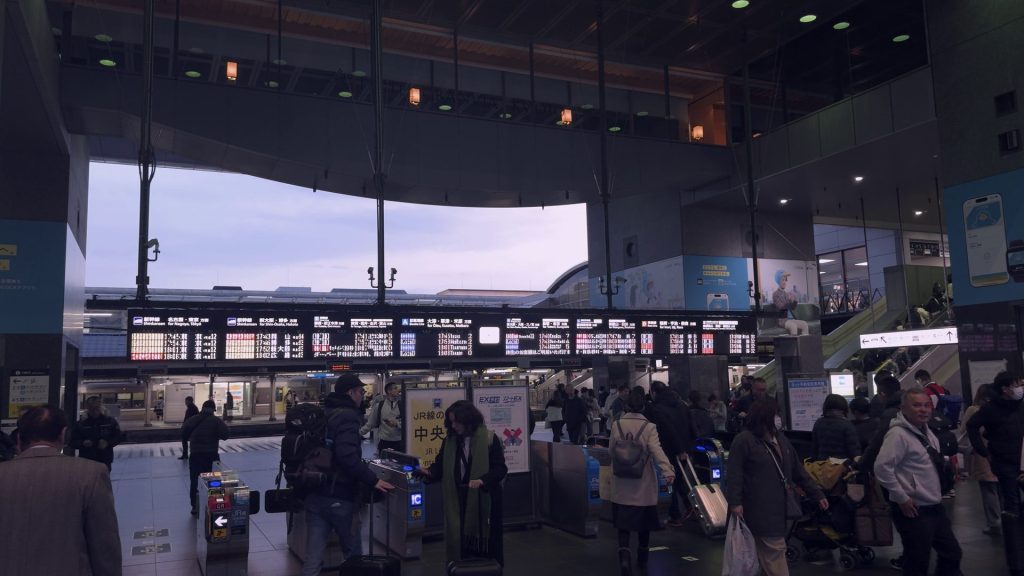
We arrive at the bustling Kyoto Station at 5:30 pm on a Saturday and take an Uber to our accommodation.
Should You Book Cathay Pacific Regional Business Class HKG to KIX?
Alternatives: Peach and Hong Kong Express
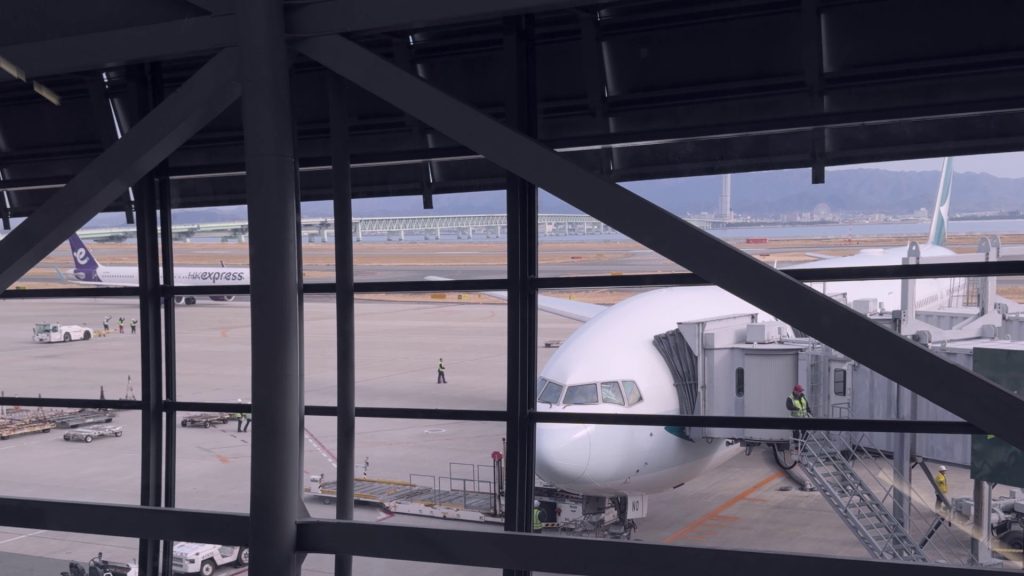
Generally speaking, you can easily do this kind of three-and-a-half-hour flight either in Cathay’s economy class or in one of the low-cost carriers such as Hong Kong Express or Peach. They certainly don’t go overboard with their service, but they’ll get you from A to B safely. If your only goal is to get from Hong Kong to Osaka as cheaply as possible, those options are absolutely worth considering.
Reasons to Book Cathay’s Regional Business Class
However, if you want to see both Hong Kong and Japan, and have already booked a business-class long-haul flight with Cathay for the first leg, it’s worth considering booking another leg on the same ticket. In many cases, this is not significantly more expensive than booking the shorter trip on another carrier.
If that works with your travel plans, the main bonus of flying Cathay’s regional business class is probably the lounge access. The Pier had been on my aviation bucket list for a while, and I’m glad we managed to include it in our travel plans.
The board product itself and the service also make the trip just that extra bit more comfortable, but the lounge is the real headline.
The Main Advantage of Regional Business Class
On a daytime flight, the older recliner seat is perfectly adequate. You get a proper meal service, lounge access, and a more spacious cabin than economy. It’s not transformative, but it is noticeably better than sitting in the back.
If you also consider the lounge time before the flight, the cumulative benefit adds up to a much more relaxing travel day, particularly if you’re already at the start of a multi-stop trip and want to set the right tone on the first flight.
- Pros:
- Lounge access at HKG (The Pier alone is worth the price of admission)
- Proper meal service with Hong Kong and Japanese dishes
- Comfortable seat for a daytime flight under four hours
- Solid power outlet at every seat
- Priority check-in, security, and boarding
- Good value when booked as a connecting leg on the same ticket
- Helpful for setting the right tone at the start of a multi-stop trip
- Cons:
- Older 2-3-2 configuration — no direct aisle access for all seats
- Non-standard headphone jack (3.5mm + 2.5mm) makes personal headphones awkward to use on the IFE
- Small IFE screen
- Not worth going out of your way for as a standalone booking
- Queue at HKG immigration can be long on weekends
- Older hard product, clearly a generation behind the 777-300ER
So, to break it down: the regional business class product that Cathay Pacific offers can be worth it if you combine it well with your broader itinerary.
It’s probably not worth going out of one’s way to book it as a standalone, but it’s definitely worth connecting via Hong Kong, spending a few days in the city, and paying a small premium to make the other legs of the trip that extra bit more comfortable.
Pros & Cons
Pros
- Excellent lounge access at HKG, especially The Pier
- Proper meal service featuring Hong Kong and Japanese dishes
- Priority check-in, security, and boarding throughout HKG
Cons
- Older 2-3-2 configuration with no direct aisle access
- Small IFE screen and non-standard headphone jack
- Hard to justify as a standalone booking given low-cost alternatives
FAQ for Cathay Pacific Regional Business Class
Quick answers to the most common questions about Cathay’s regional business class on the HKG–KIX route and similar short-haul Cathay flights.
What aircraft does Cathay Pacific fly on the HKG to KIX route?
Cathay typically operates the Boeing 777-300 on the HKG–KIX route with a 2-3-2 regional business class layout. On long-haul routes, you’ll more often see the 777-300ER with the 1-2-1 reverse herringbone configuration. The aircraft type is the single biggest factor in determining which Cathay business class product you’ll get.
Is Cathay Pacific regional business class the same as long-haul business class?
No. Regional business class uses an older product with a 2-3-2 configuration and recliner-style seats, while long-haul business class (on the 777-300ER or A350) uses a 1-2-1 reverse herringbone layout with fully lie-flat seats. The regional product is fine for daytime flights under four hours but is not designed for overnight or red-eye routes.
Which Cathay lounge is best at Hong Kong International Airport (HKG)?
All three Cathay business class lounges at HKG are worth a visit: The Pier, The Wing, and The Bridge. The Pier (covered in detail above) features a strong Hong Kong food spread and a tea house area. The Wing is known for its noodle bar and shower suites.
The Bridge is the largest and most recently refreshed, with sweeping views of the runway. Choice depends on which gate you’re departing from and how much time you have.
How do I get from Kansai Airport (KIX) to Kyoto?
The fastest and most convenient option is the Haruka Express, a JR train that runs directly from KIX to Kyoto Station in about 75 minutes. You can buy tickets at the JR ticket office inside the airport or online. It’s also the most scenic option, with views of the Japanese countryside as you approach Kyoto.
Should I book Cathay or a low-cost carrier for HKG–KIX?
Book Cathay regional business class if you also have a long-haul Cathay business class flight and want to book the connecting leg on the same ticket, or if lounge access at HKG is important to you. Book a low-cost carrier (Hong Kong Express or Peach) if you just want the cheapest way to get from Hong Kong to Osaka.
The flight time is similar across all three options — about three and a half hours.
Is Cathay regional business class worth the price?
As a standalone, no. The price premium over economy is hard to justify on a three-and-a-half-hour daytime flight.
As a connecting leg on a Cathay long-haul business class itinerary, yes. The lounge access at HKG, priority check-in and boarding, and the more comfortable seat add up to a meaningful upgrade — particularly on a multi-stop trip where you want to set the right tone from the first flight.
My Travel Gear on this Flight
Here is the travel gear I used on this regional Cathay flight and the rest of the Japan leg:
- The North Face Suitcase
- The North Face Backpack
- Victorinox Carry On
- Phone/Camera
- Bluetooth Headphone Adapter with Aeroplane Plug
- Travel Power Adapter
- Travel Portable Fan
- Travel Portable Fan (International)
- Recording SSD Enclosure
- Travel SSD
- Share this post with someone planning a trip to Japan or Hong Kong!
- Bookmark MidAirTimes.com for more airline reviews, travel tips, and local guides.
- Leave a Comment: Have you flown Cathay’s regional business class? Is The Pier lounge worth the hype? Let us know below!
What’s Next in this Series?
With Hong Kong behind us and Kyoto ahead, the next stop in this series takes us through Japan before we fly back from Tokyo via Hong Kong to Frankfurt. If you want to know whether Cathay is worth the premium on long-haul flights, make sure to check our previous review, where we flew with Cathay from Frankfurt to Hong Kong.
Stay tuned for more travel content from Japan and the return flight from Tokyo!
Thank you for reading, and see you in the next post!
Disclaimer: Some links in this post are affiliate links, meaning we may earn a small commission at no extra cost to you if you purchase through them. This helps support the blog so we can continue to provide quality travel content. Thank you for your support!
Leave a Reply