

Last updated: 8 June 2026. Written by Lasse Dyre, founder of Midair Times. Read our editorial standards.
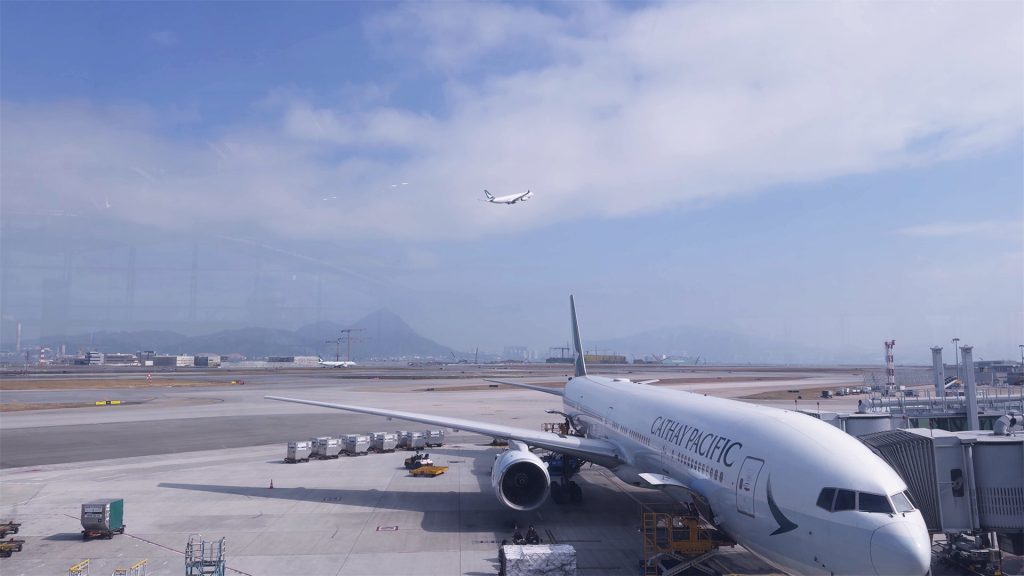
In this Cathay Pacific business class review, we will look at Cathay Pacific Business Class on a long-haul flight from Frankfurt (FRA), Germany, to Hong Kong (HKG) on board the Boeing 777-300ER (flight CX288). This Cathay Pacific business class review covers the seat, meal service, in-flight entertainment, and the practicalities of flying Cathay business class on the FRA-HKG route in 2025.
Cathay is widely regarded as one of the most prestigious carriers out of Asia. As the airline is in the middle of rolling out its brand-new Aria Suite, the question I get asked most often right now is: Is the current business-class product still worth flying? In this post, we’ll go through the full experience, from the on-ground setup at FRA, through boarding, the seat, the meal, and even a quick look at the hotel we stayed at in Hong Kong. So if you’re weighing up a Cathay business class ticket before the Aria Suite rollout reaches your aircraft, this review should help.
Disclosure: This article contains affiliate links. If you buy through these links, we may earn a commission at no extra cost to you. We only recommend products and services we have personally tested.
In This Cathay Pacific Business Class Review
Watch the full review on YouTube and subscribe to the channel for the rest of this Asia trip series!
Quick Verdict
Cathay Pacific’s 777-300ER business class on the 9,200-kilometer FRA-HKG route delivers a solid reverse herringbone seat with direct aisle access, excellent meal service, free WiFi, and a premium Bamford amenity kit. The cabin shows its age with dated IFE screens and warm temperatures, but it remains a competitive choice for the 12-hour flight between Europe and Hong Kong.
Quick Flight Info
Here’s a snapshot of the flight covered in this review:
- Outbound (FRA → HKG)
- Airline / Flight Number: Cathay Pacific / CX288
- Date: Saturday, 14 December 2024
- Departure: 12:00 (CET) from Frankfurt International Airport (FRA), Terminal 2
- Arrival: 07:00 (+1 day, HKT) at Hong Kong International Airport (HKG)
- Aircraft: Boeing 777-300ER
- Cabin: Business Class
- Effective Flight Time: ~12 hours (plus ~20 min delay on arrival)
Pre-Flight Experience
Priority Lounge at Frankfurt (FRA)
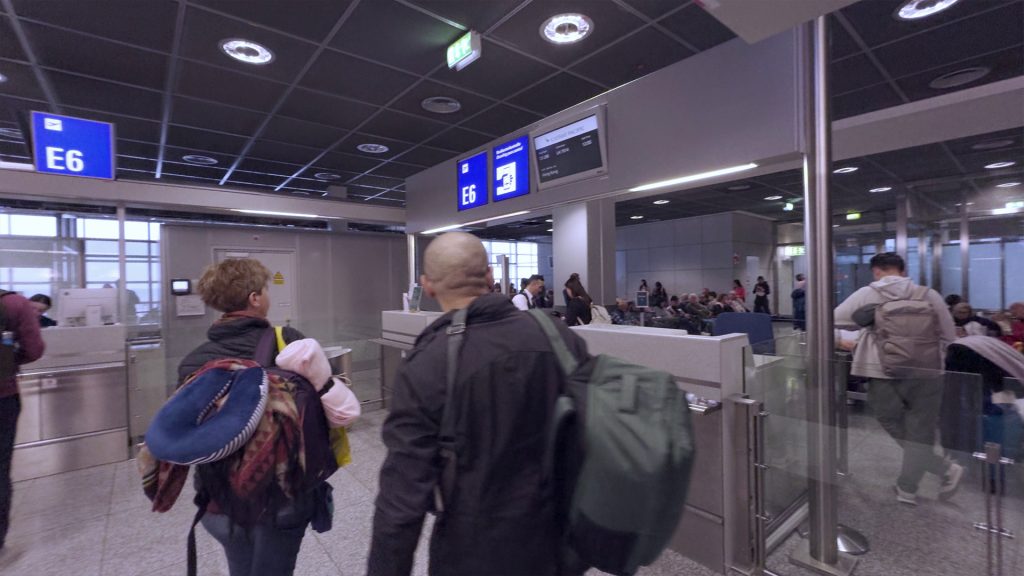
Cathay Pacific departs from Terminal 2 at Frankfurt, and business class passengers are directed to the Priority Lounge near gates E6 to E9. The location is convenient—boarding today was actually right from E6—but the lounge itself is, honestly, basic at best. It’s part of the Priority Pass network and shared with more than a dozen other airlines, which shows. It’s often crowded, the food and drink options are modest, and while it does the job if you want a seat and a drink, that’s really the extent of the experience.
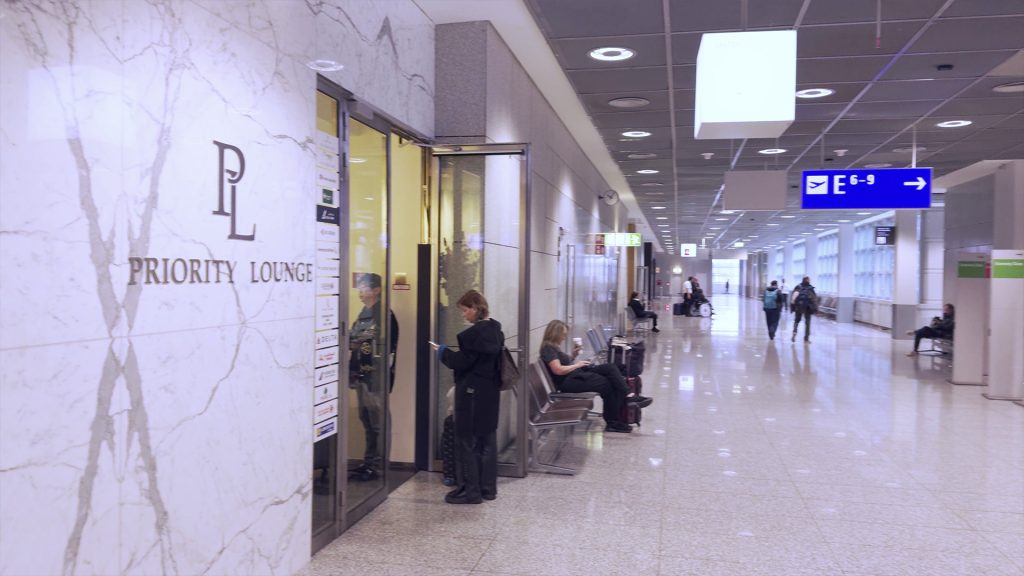
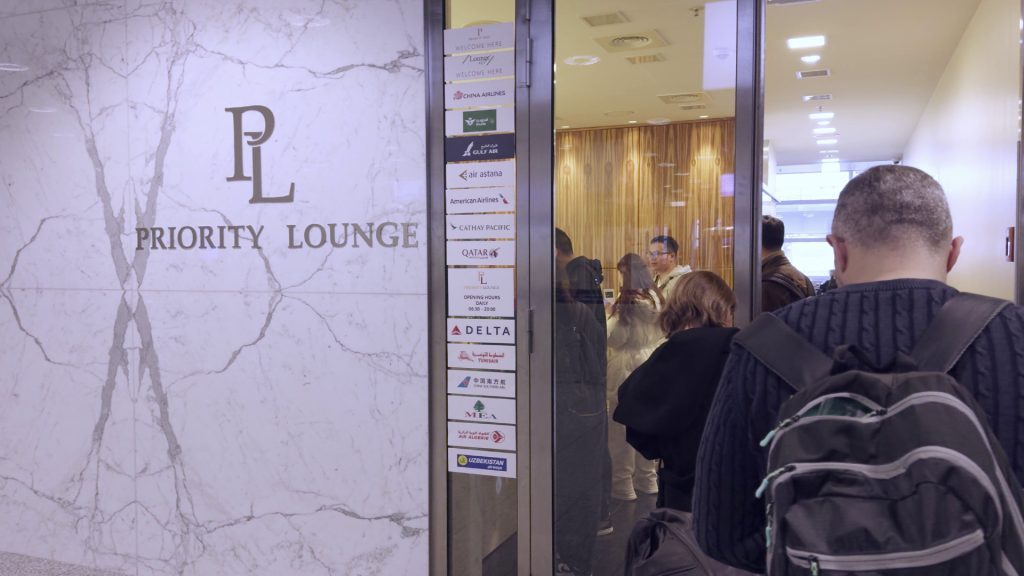
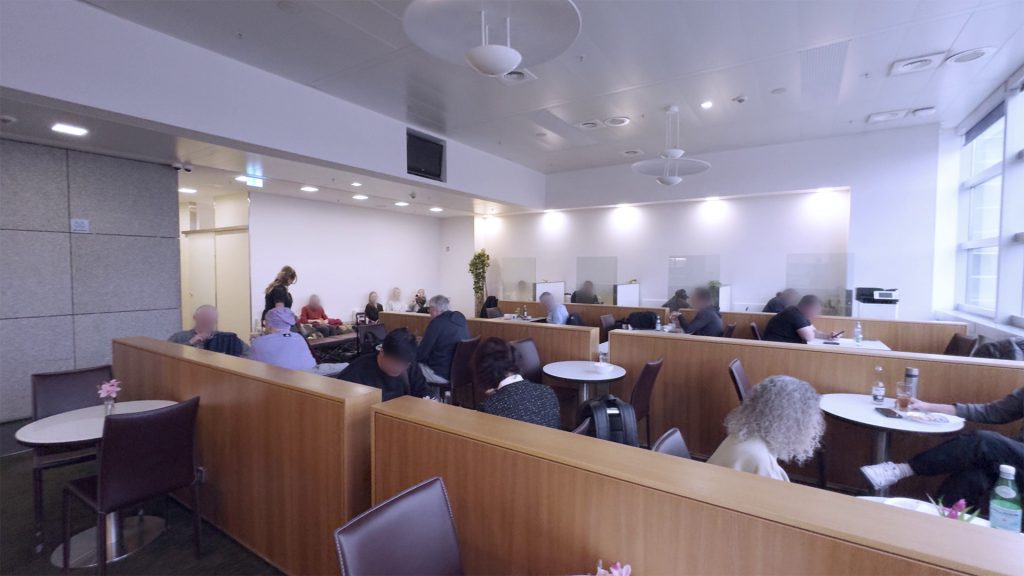
Tip: The Priority Lounge is shared across many carriers. Don’t expect the kind of polished, branded experience you’ll get at a Cathay lounge in Hong Kong. Treat it as a place to grab a drink, charge your phone, and move on.
What makes this setup even less appealing is gate E6 itself. Unlike many gates in Frankfurt, E6 has its own dedicated security checkpoint right before boarding. Hence, you need to leave the lounge with enough buffer to deal with a security line that can get quite busy before pushback. This is probably my least favourite gate setup at FRA, so manage your expectations for the on-ground experience.
Boarding and Cabin Impressions
Boarding the Cathay 777-300ER
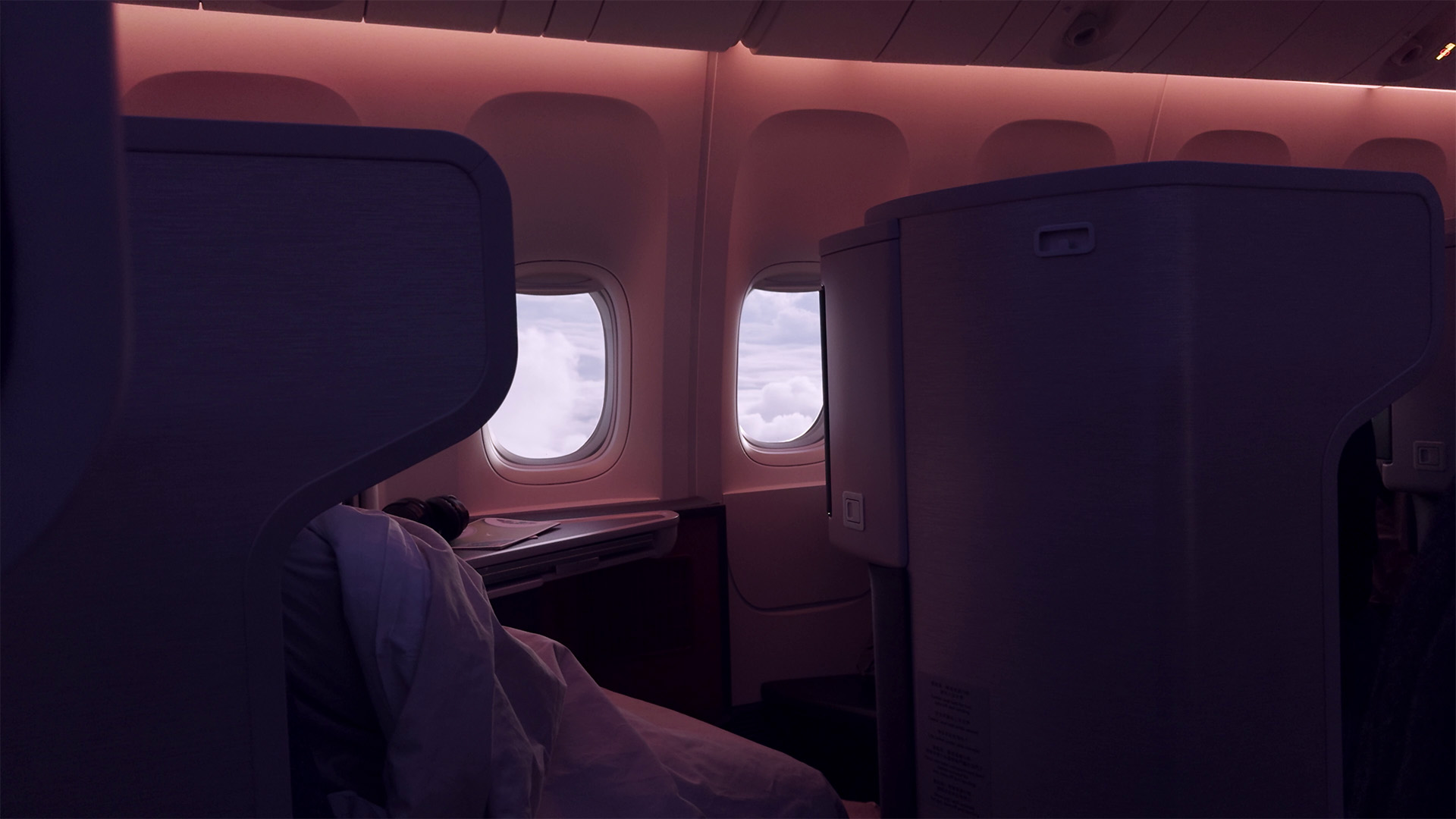
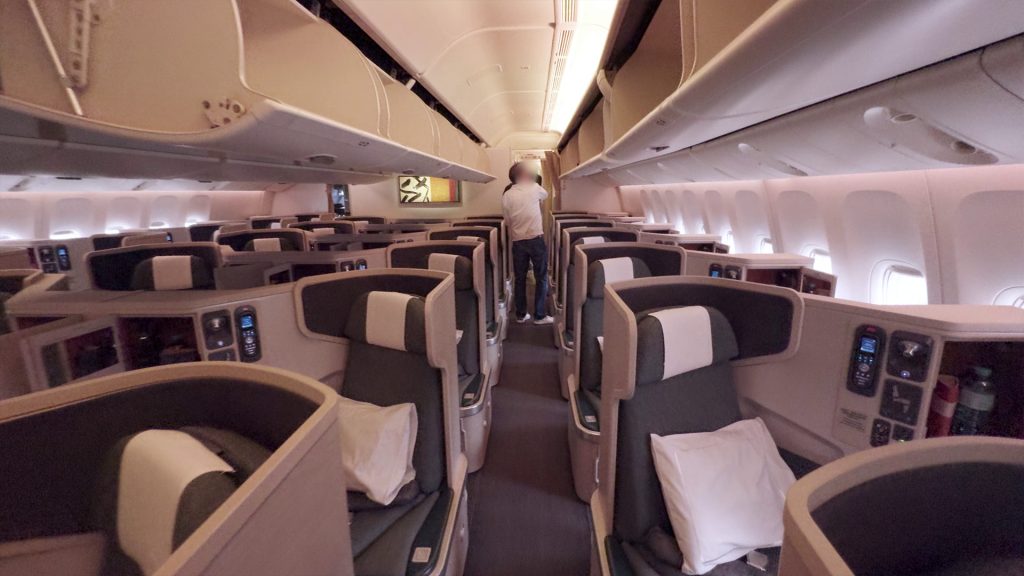
Once past the gate, boarding is direct via the jet bridge. Stepping into the cabin, the first thing that strikes me is how compact and enclosed it feels, largely due to Cathay’s decision to install overhead bins above the middle seats. Some airlines go for a more open feel by only using bins above the window seats, but Cathay’s setup gives the cabin a somewhat “cozy” atmosphere. I personally prefer this look. It makes the space feel a bit more private, even if technically more crowded. It’s all held together in dark, almost moody tones with subtle deep red accents, very much in line with a Hong Kong aesthetic. It’s less of a polished luxury look and more of a grounded elegance, I’d say.
Business Class Configuration
The Cathay 777-300ER comes in a 1-2-1 reverse herringbone layout in business class. A few things worth knowing before you book:
- Direct Aisle Access: Every seat has direct aisle access, i.e., no need to climb over a neighbouring passenger.
- Window seats are turned towards the window for added privacy.
- Middle seats are angled slightly toward each other but are separated by a wall and the headphone compartments. So, these are not “honeymoon seats” as you’ll find on some other layouts. It’s a great cabin for solo travellers, but less ideal if you’re a couple hoping to lean in for a chat over dinner.
Tip: Pick an even-numbered window seat (e.g., 11A or 11K) for maximum privacy in this cabin. Odd-numbered rows give you the same seat, but with the door/galley area visible in your line of sight.
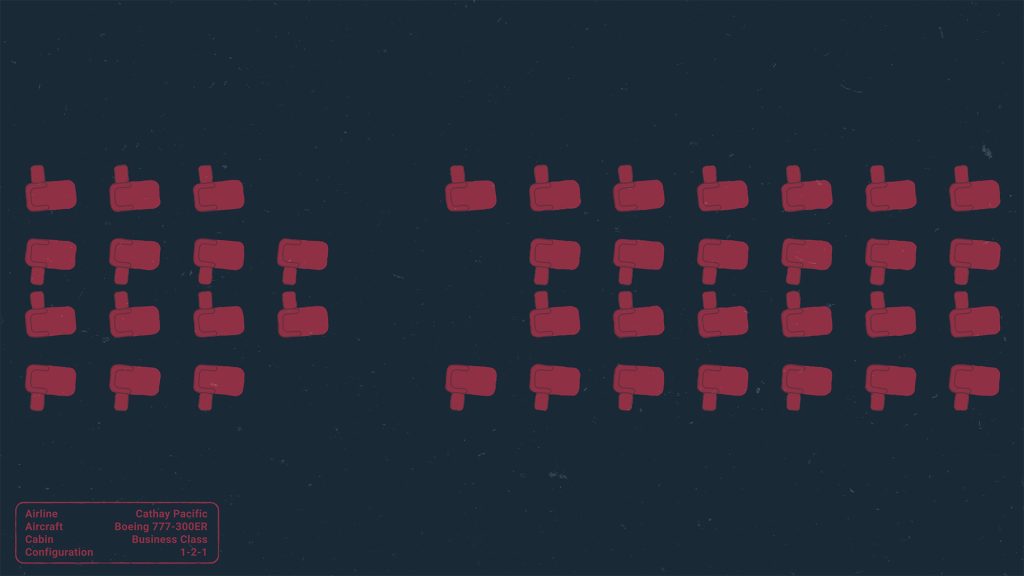
Despite its age, the seat itself is clean and still solid. Some panels feel a little loose in places, and a few surfaces show their age, but the seat offers ample personal space and storage.
Amenities and Seat Comfort
Bamford Amenity Kit
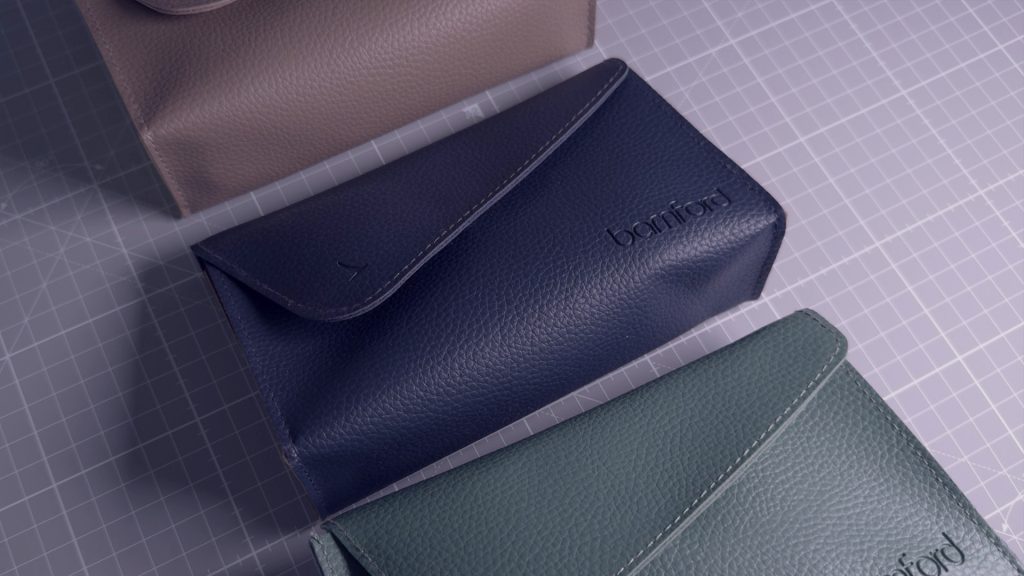
Waiting at the seat is the Bamford-branded amenity kit. In terms of the packaging, this might be one of my favourites. It comes in a compact leather-optic design with a nice magnetic closing mechanism. I usually don’t mind how luxurious an amenity kit is, but I do prefer something that I can reuse in my day-to-day life, and this little bag is genuinely a nice organiser for a handbag or backpack.
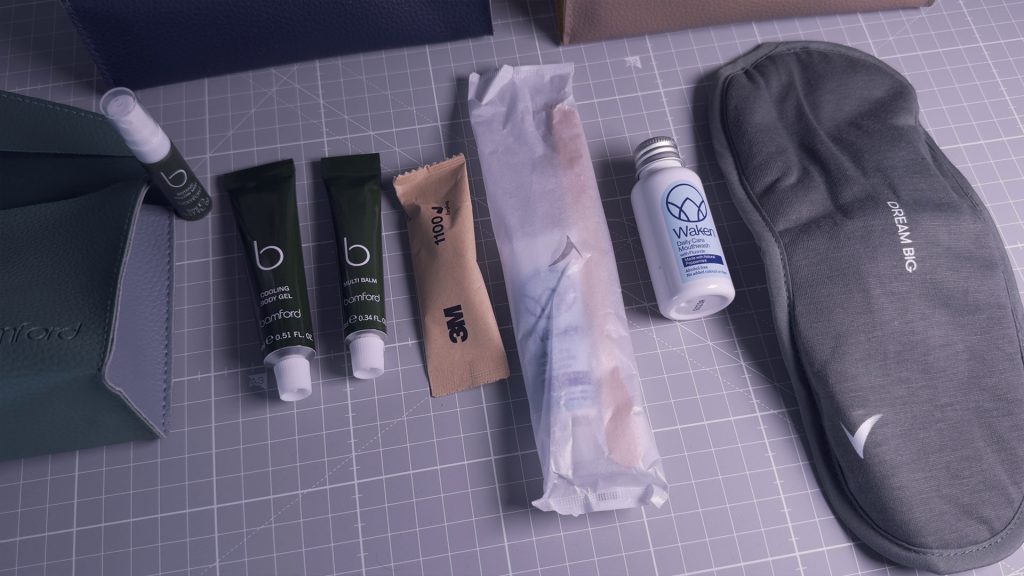
Inside, the usual suspects—toothbrush, toothpaste, eye mask, earplugs, lip balm—plus some nice extras:
- Mouthwash
- Pillow mist
- Cooling body gel (which would have come in handy later… if I had remembered it was in there)
Bathrooms
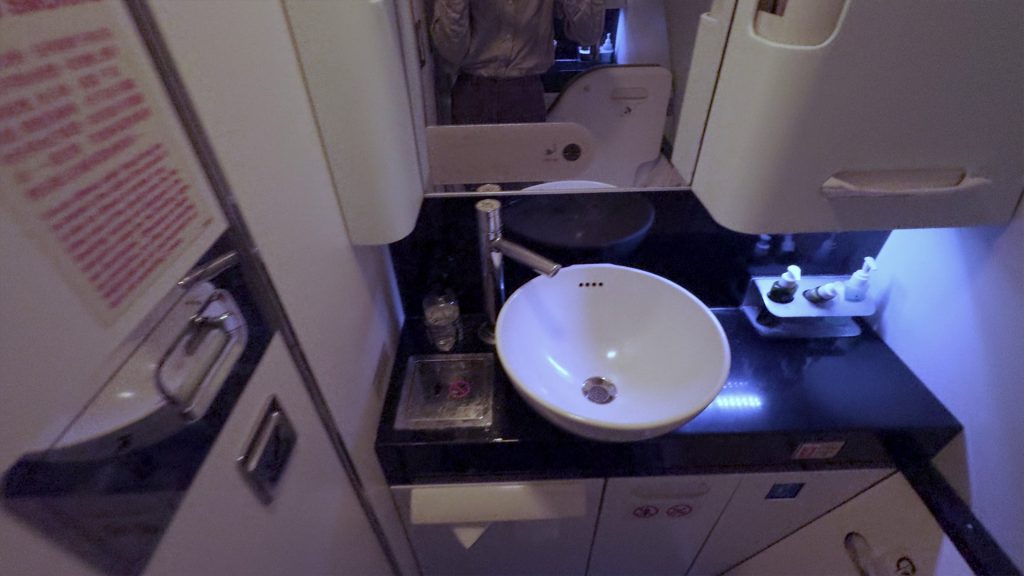
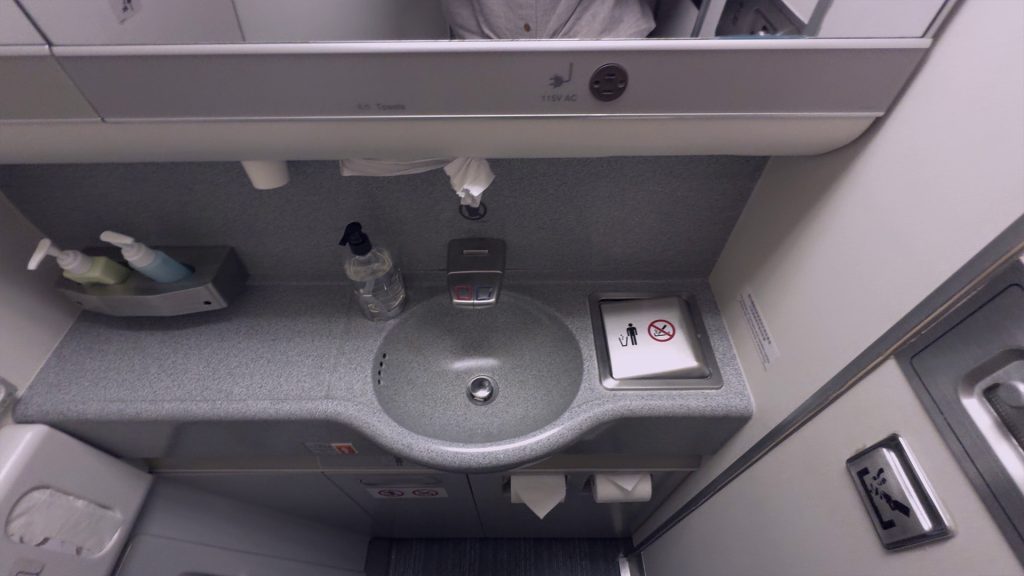
There are two business class bathrooms at the front of the cabin, and they’re very different:
- The left-hand one is surprisingly spacious and comfortable, though not exactly pristine.
- The right-hand one is noticeably smaller and more cramped.
Neither was particularly well maintained throughout the flight, but if you have the option, aim for the one on the left.
In-Flight Services
Meal Service (Lunch)
With an early pushback, we take off just after noon. The crew begins service with a hot towel, a small but appreciated detail that not every airline has brought back post-pandemic.
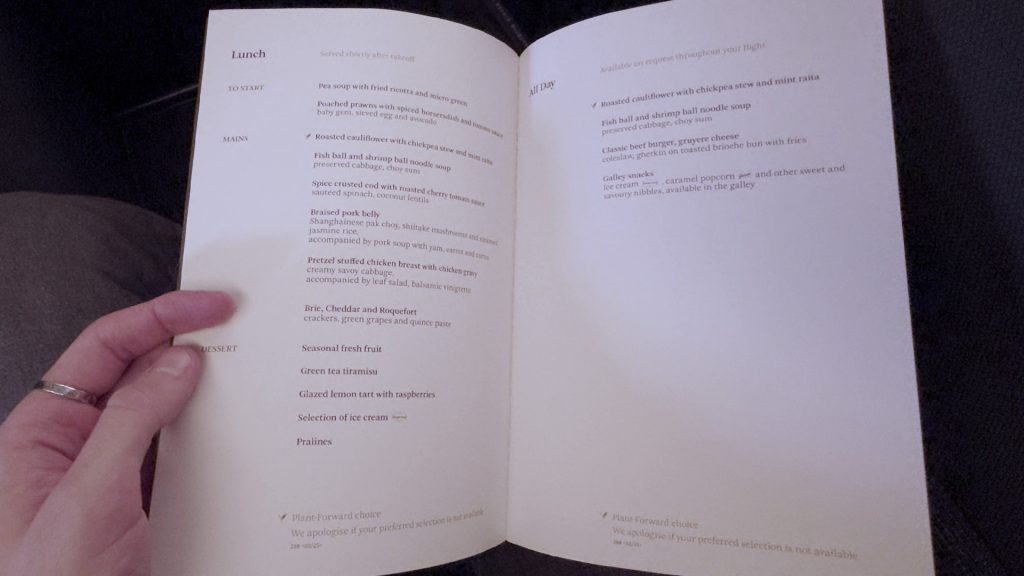
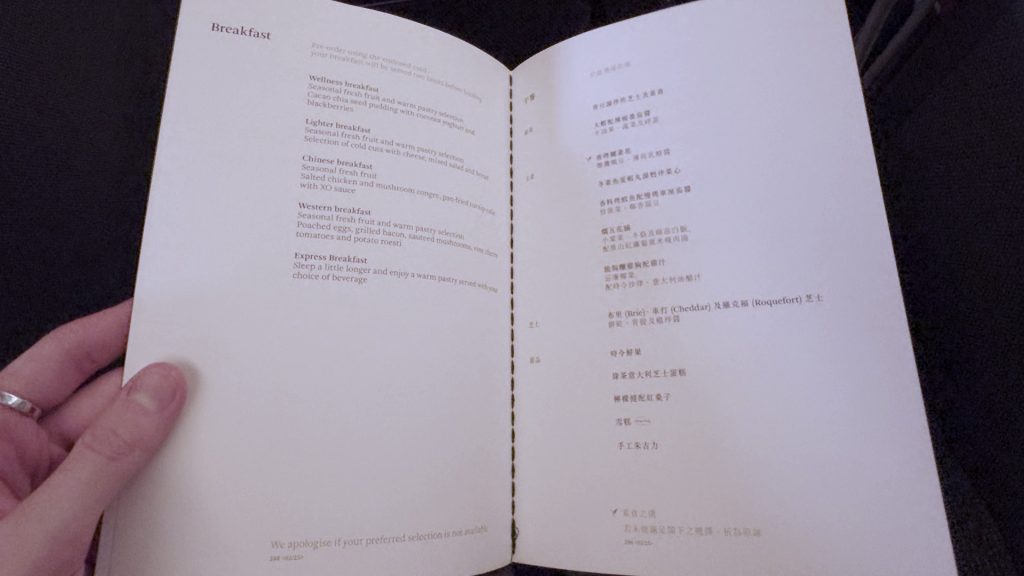
Cathay’s menu reflects its roots, with a strong emphasis on seafood-forward Hong Kong cuisine alongside some Western options. What stands out immediately is the inclusion of a vegetarian main dish in the regular menu, in this case a cauliflower and chickpea stew with mint raita. This is also available on the dine-on-demand list throughout the flight, which is a real bonus for the second half of a 12-hour flight. It’s rare to see a vegetarian option featured so prominently on this route, and it sets a good tone for the meal service overall.
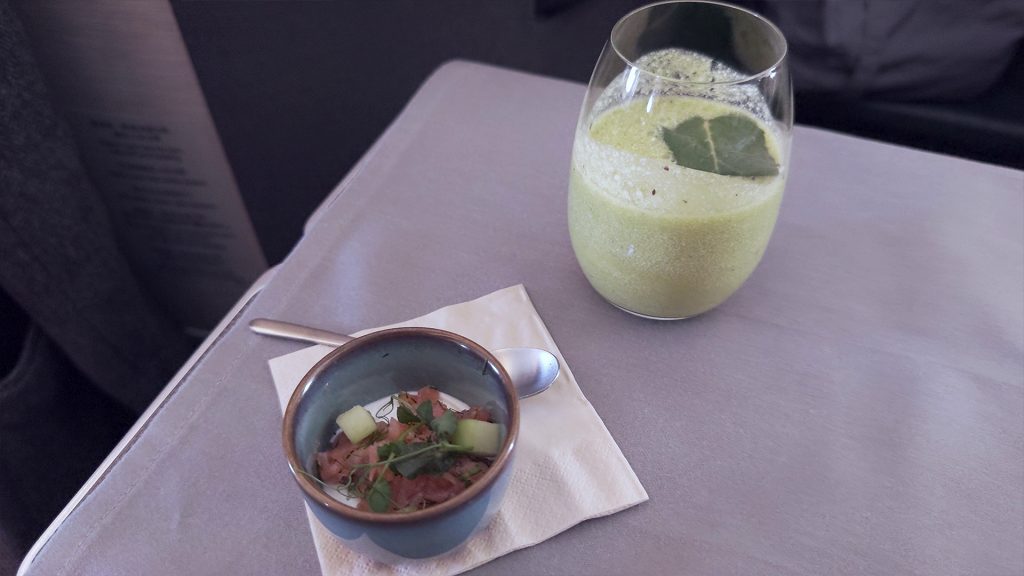
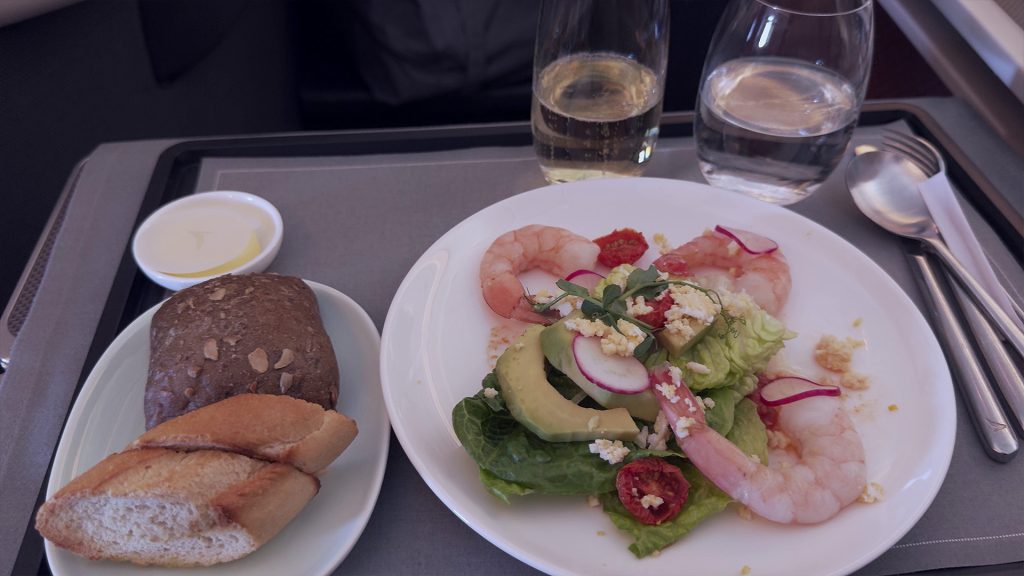
The first course arrives at around 1:10 pm. The appetizer is great, especially paired with a Cathay Delight, Cathay’s signature mocktail made with coconut milk and kiwi juice. The prawns are fine, but nothing that really stands out.
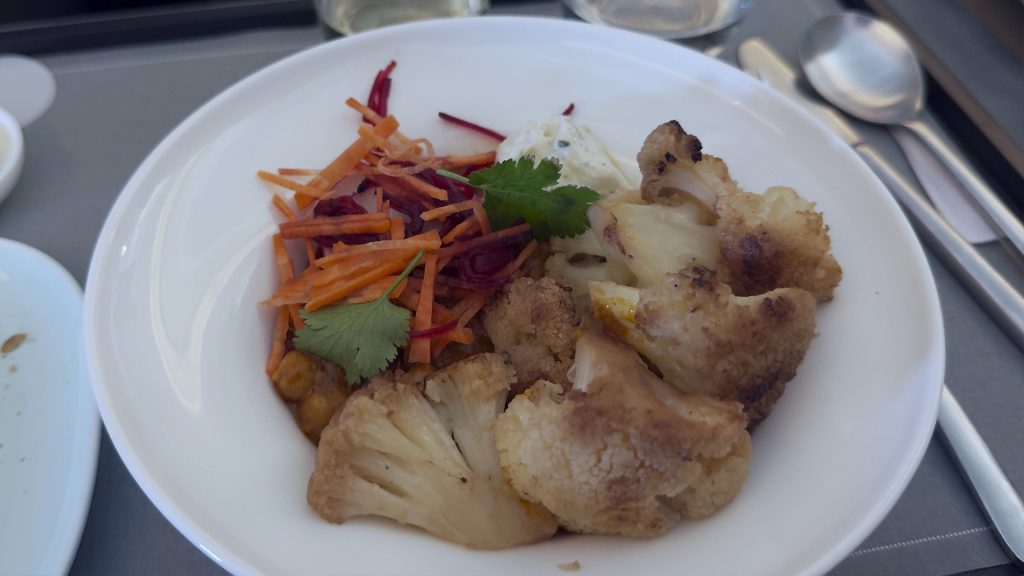
The main course, though, absolutely does. The cauliflower and chickpea stew is, to date, my favourite in-flight meal. It’s rich and well-balanced, with flavours that go far beyond the usual airline fare. The cauliflower has a nicely browned, almost pan-fried texture, and the stew, which feels more like a curry, is hearty without being too heavy. The mint raita adds just enough brightness. If I hadn’t been so full, I would have happily gone for a second serving from the all-day menu.
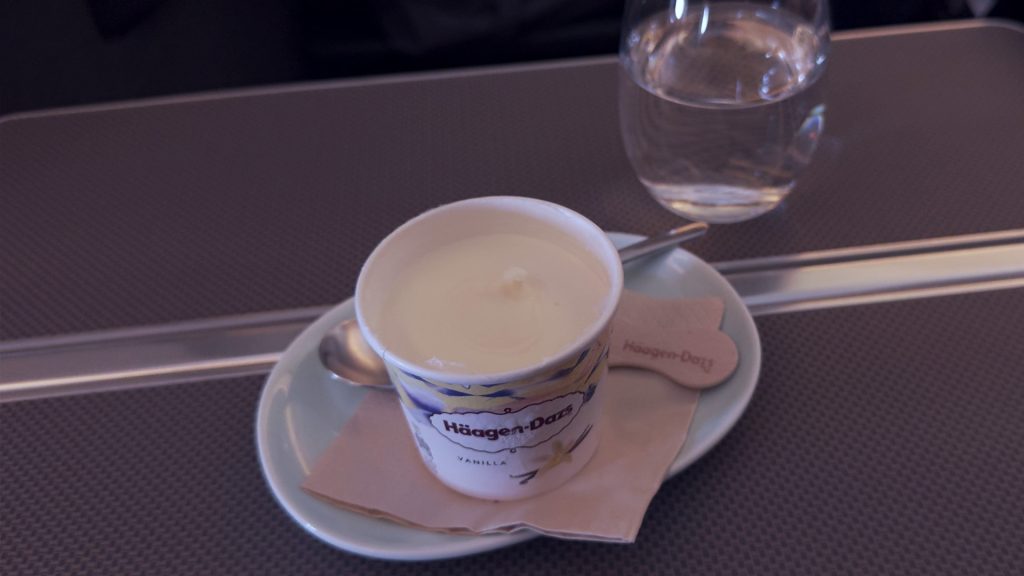
The lunch meal service wraps up with ice cream.
Pre-Arrival Meal (Breakfast)
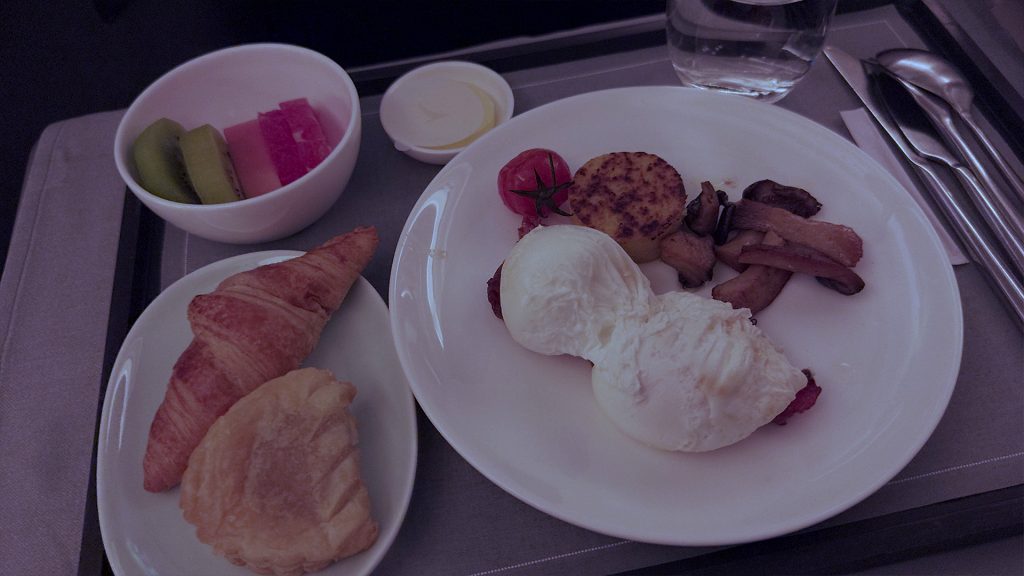
After a few more hours of light sleep, the breakfast service begins, served all at once on a single tray. The meal is fine and does the job, but it isn’t particularly memorable.
In-Flight Entertainment (IFE)
That brings us to the inflight entertainment, which is something Cathay generally does quite well. The content selection is broad, with a good mix of international films, series, documentaries, and regional programming. One helpful feature is the ability to mark items as favourites while browsing, making it easier to queue content without having to scroll through the full catalogue later.
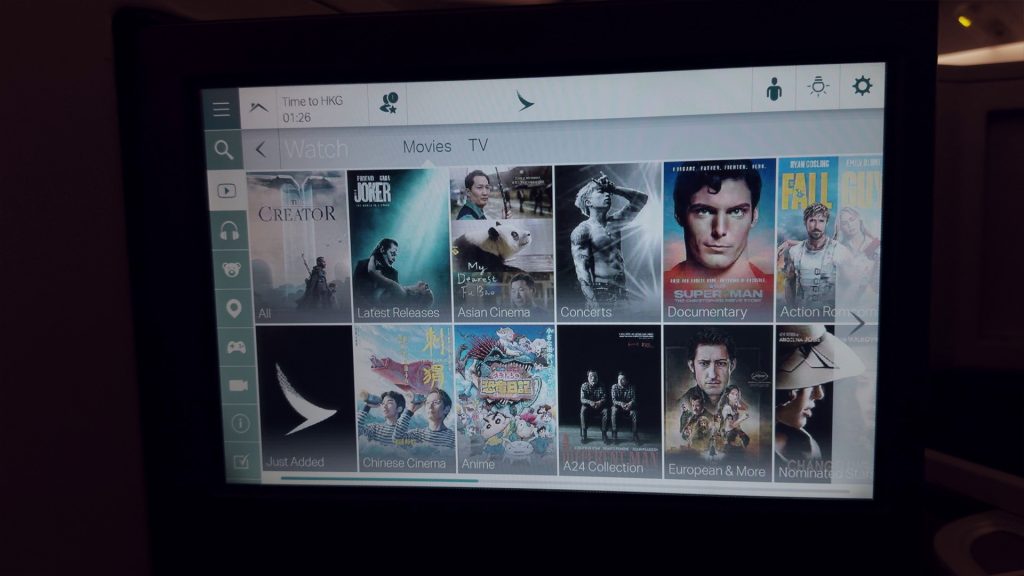
That said, the hardware doesn’t quite match the quality of the content. The screens in this cabin are just fine at best. Resolution is middling, colours are slightly washed out, and responsiveness isn’t great. They do the job, but feel noticeably behind the curve. Without being able to confirm it technically, the screens in this flight’s economy cabins might actually feel sharper, at least judging from memory.
WiFi: Free in Business Class
All Cathay flights in this series—both long-haul and regional—now include free WiFi for business class passengers. Connecting is straightforward, especially if you know the usual workaround that I cover in my YouTube shorts. Once online, the network is decently stable for most of the flight and fast enough for emails, browsing, and even a bit of streaming.
Sleep, Snacks, and Cabin Comfort
The Lie-Flat Bed and Bedding
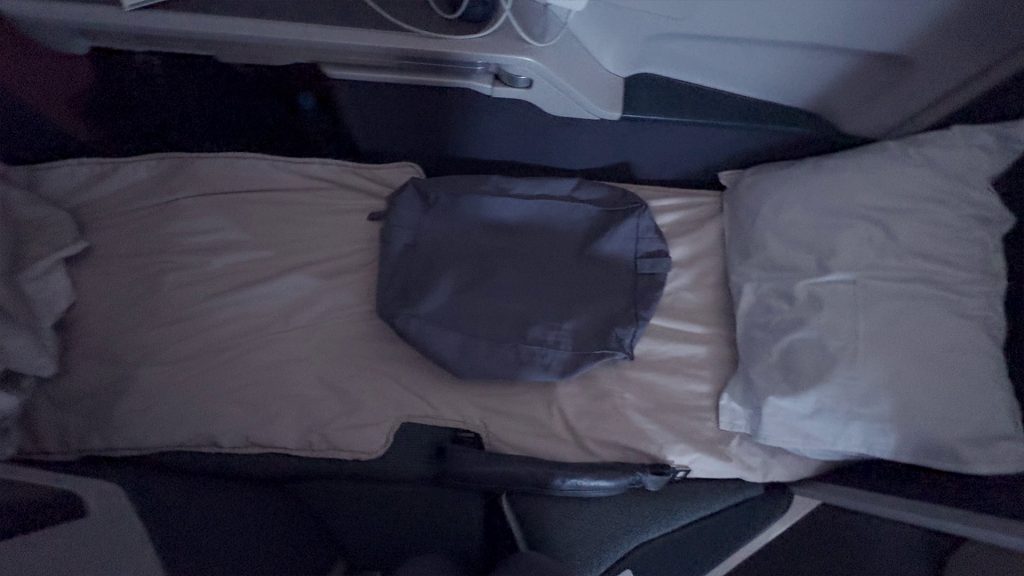
After a movie and a bit of browsing, it’s time to take a rest. The seat converts into a fully lie-flat bed and comes with a mattress pad, which instantly makes a difference. The seat is quite roomy when reclined and, compared to other business-class designs, offers a noticeable sense of space. You don’t feel boxed in, and with the armrest raised, there’s a decent amount of privacy for a non-suite layout.
The bedding is also well above average. The blanket is thick and feels high-quality, and the pillow is perfectly fine as well. It’s the kind of setup that could easily make for a comfortable night’s sleep… if only the cabin temperature allowed it.
Cabin Temperature and the Portable Fan
For reasons I don’t know, the cabin gets uncomfortably warm as the flight progresses, and lying under the thick duvet becomes a bit of a challenge. My saving grace on this trip is a small portable travel fan (Amazon | AliExpress) that I packed despite it being winter. If you’re someone who runs warm or just likes to have control over your microclimate, I genuinely recommend bringing one.
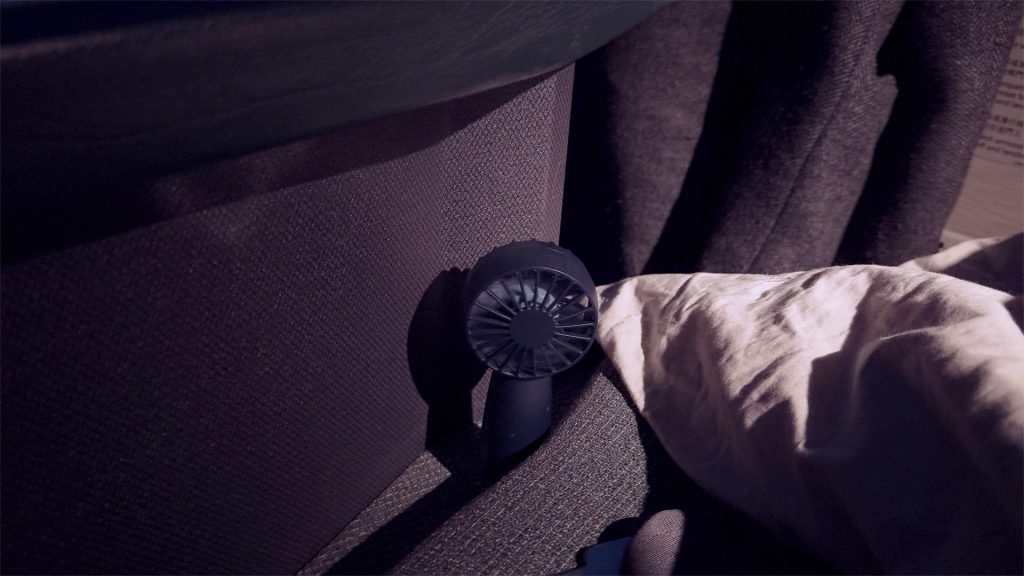
Tip: Cabin temperature on long-haul flights is one of the most underrated comfort factors. A USB-powered personal fan weighs almost nothing, takes up no extra space in your bag, and can turn a sleepless flight into a much more bearable one, especially on older cabins like this one, where the temperature control isn’t great.
Snacks From the Galley
Outside of the temperature, the rest of the flight runs smoothly. Sometime in the second half, my flight companion and I take a walk to the galley and help ourselves with the available snacks. The fresh caramel popcorn definitely stands out. It’s very sweet, but if you’ve got a bit of a sugar craving mid-flight, it’s a great choice.
In-Flight Gadgets That Saved the Day
One thing that does noticeably elevate the experience—especially on an older seat like this one—is bringing the right gadgets. Two items in particular made this flight noticeably more comfortable:
Bluetooth Headphone Adapter
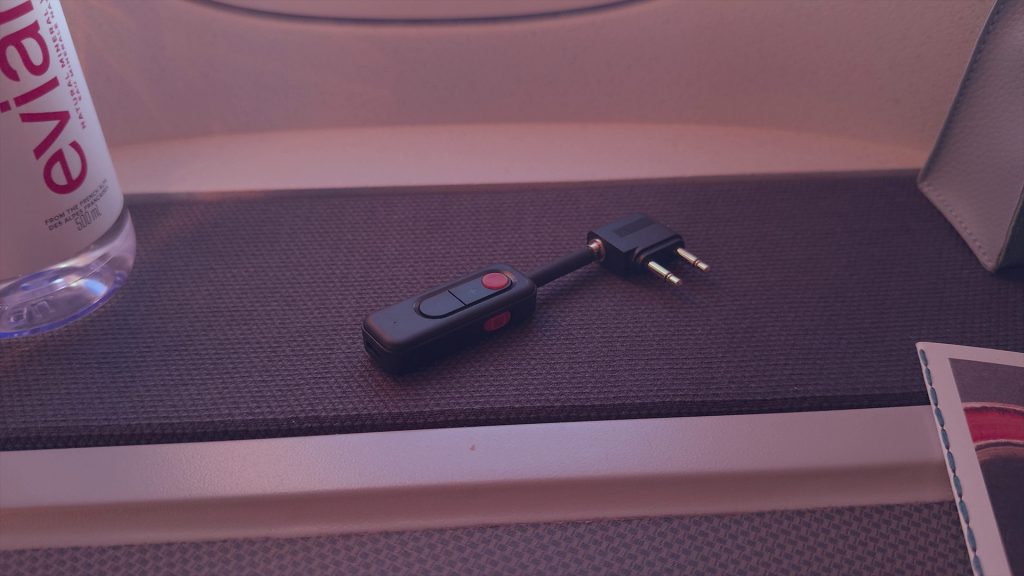
While some airlines are slowly introducing wireless headphone pairing in their newest cabins, the majority—including this 777—still rely on the classic double-pin headphone jack. And the provided headphones are not always great either. If you want to use your own wireless in-ear headphones, a small Bluetooth transmitter is an easy fix (AliExpress). You simply plug it into the headphone port and pair it with your own Bluetooth headphones. It’s inexpensive, weighs almost nothing, and, for me, makes a surprisingly big difference in comfort.
Especially if you’re usually bringing your over-ear noise-cancelling headphones just for the flight, you can save a lot of space by bringing a transmitter and your AirPods instead, which is something I’ll be doing from now on.
Travel Power Adapter
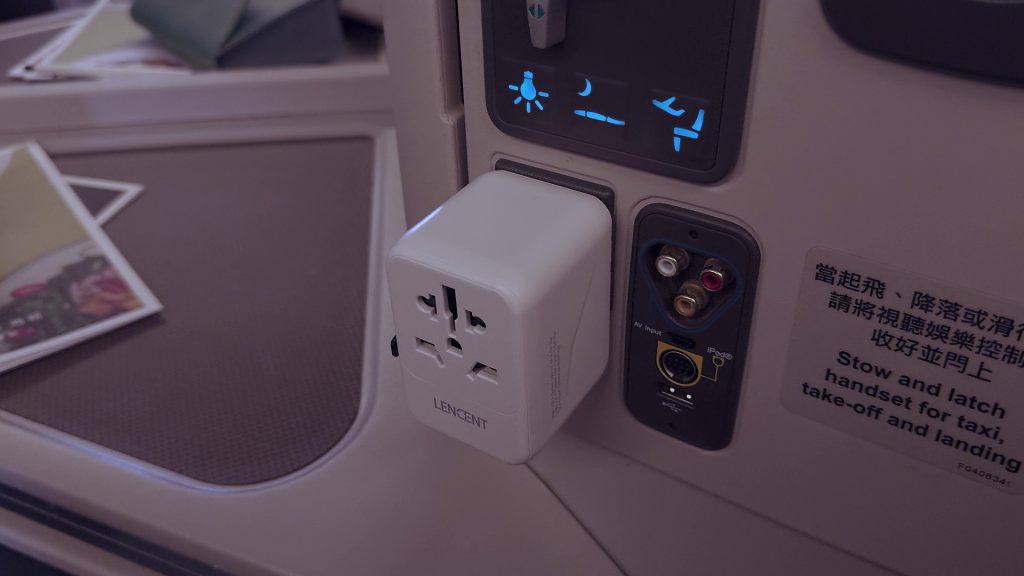
Another staple of my in-flight gadgets is my Lencent travel adapter (AliExpress). Cathay’s USB-A ports, like those on many older aircraft, are basically a trap: they charge incredibly slowly, tend to overheat your device, and, at best, serve only as a battery-life preservation tool. In contrast, the universal power outlet at the seat is significantly more reliable. Paired with my Lencent adapter—which includes three USB-A ports, one USB-C, and a universal socket—I’m able to charge my phone, tablet, and laptop without issue. It’s compact, reliable, and has travelled with me for years.
Arrival at Hong Kong (HKG)
Not too much later, we approach Hong Kong International Airport on a rainy winter morning. Touchdown is at 7:00 am local time, with a slight 20-minute delay. Disembarkation is smooth, and we make our way toward immigration.
Immigration takes a moment, but gives us time to buy Airport Express tickets on our phones while waiting in line. Our luggage arrives not long after we reach the luggage belt, and just like that, we’re through and out into the city.
Getting Connected on Arrival: Airalo eSIM
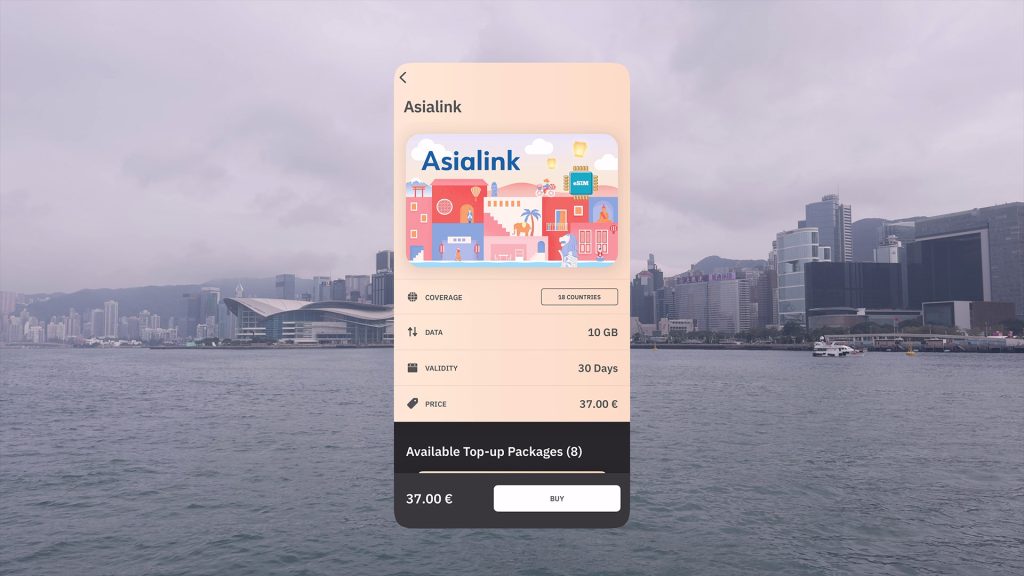
Before we even get to the hotel, we’re already connected to the local network thanks to mobile data from our trusted Airalo eSIM. Especially on a multi-country trip like this one through Asia, Airalo’s Asialink plan proves incredibly convenient. We purchase and install the eSIM back home in Germany, and it connects automatically upon landing.
If you’re planning a similar itinerary across Asia, the Asialink plan gives you coverage across multiple countries for a fraction of what most roaming packages would cost. And setup takes just a few minutes.
- Link to Airalo’s Asialink Plan: Airalo Asialink eSIM
- New Airalo customers: 15% off with code
NEWTOAIRALO15- Existing Airalo customers: 10% off with code
AIRALOESIM10

The Murray Hong Kong (GHA Discovery)
With data sorted, we take the Airport Express into the city. At Hong Kong Station, we scan the pre-purchased train ticket, ride up to the ground level, and step out right next to the IFC Mall, a central spot with plenty of options for taxis and hotel shuttles. The Murray Hotel provides a shuttle service from Hong Kong Station, which we catch just in time.
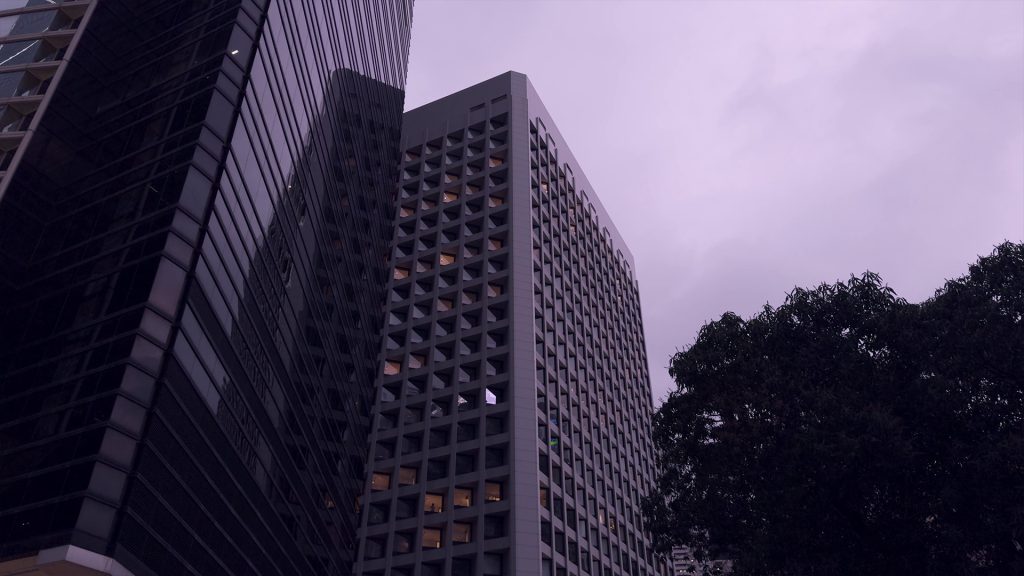
The Murray is a building that’s hard to miss. Originally built in the late 1960s as a government building, it’s a striking example of modernist architecture and a rare piece of design history in a city better known for its glass towers. We’d noticed it on previous visits to Hong Kong, so staying here this time felt like checking a box on the architectural curiosity list.
Today, it has been rebuilt into a luxury hotel and is part of the Global Hotel Alliance (GHA). If you hold an American Express credit card, there’s a good chance you already have status with GHA Discovery, unlocking perks like free room upgrades, early check-in, and late check-out.
We didn’t have GHA status on this trip, but the front desk was still kind enough to grant us a very early check-in, free of charge.
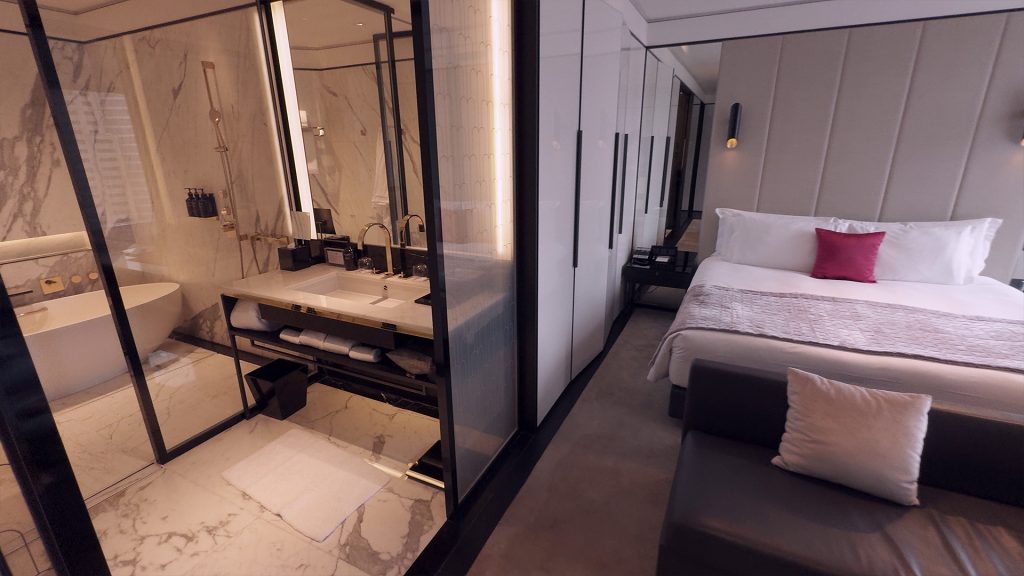
N3 Grand Deluxe Room
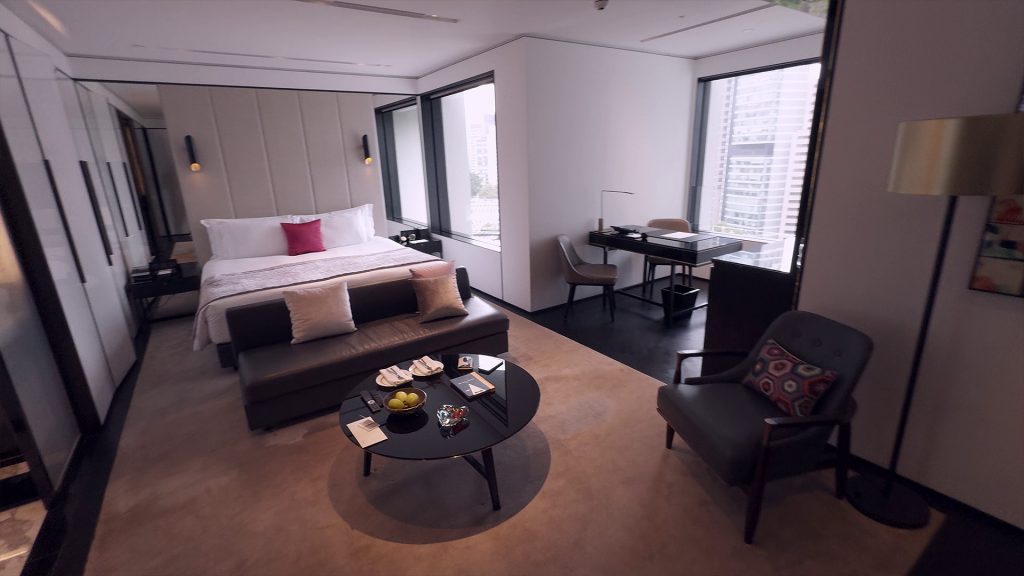
We stayed in the N3 Grand Deluxe Room, which comes with a spacious double bed, a bathtub, and a city view.
Breakfast at The Murray
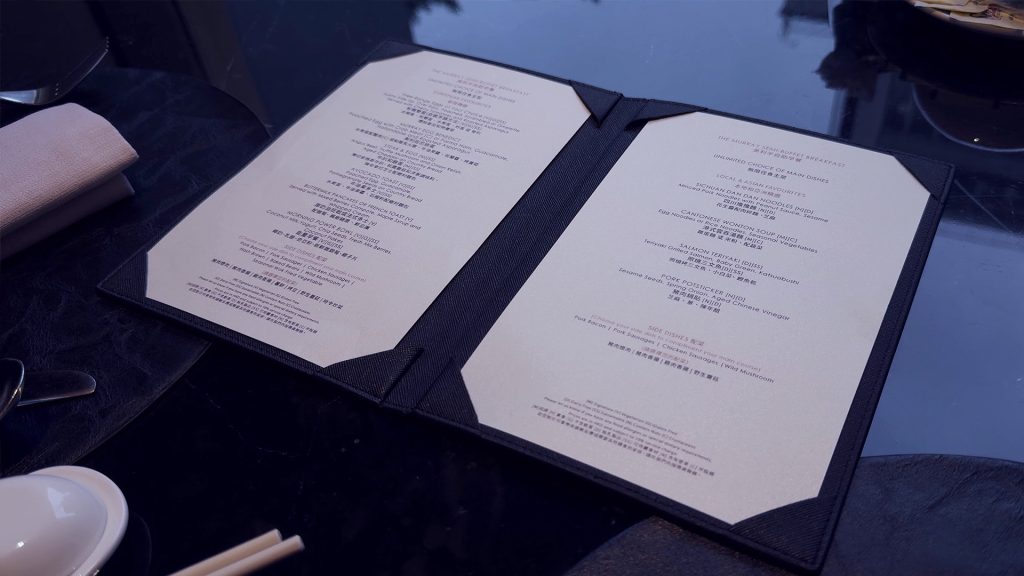
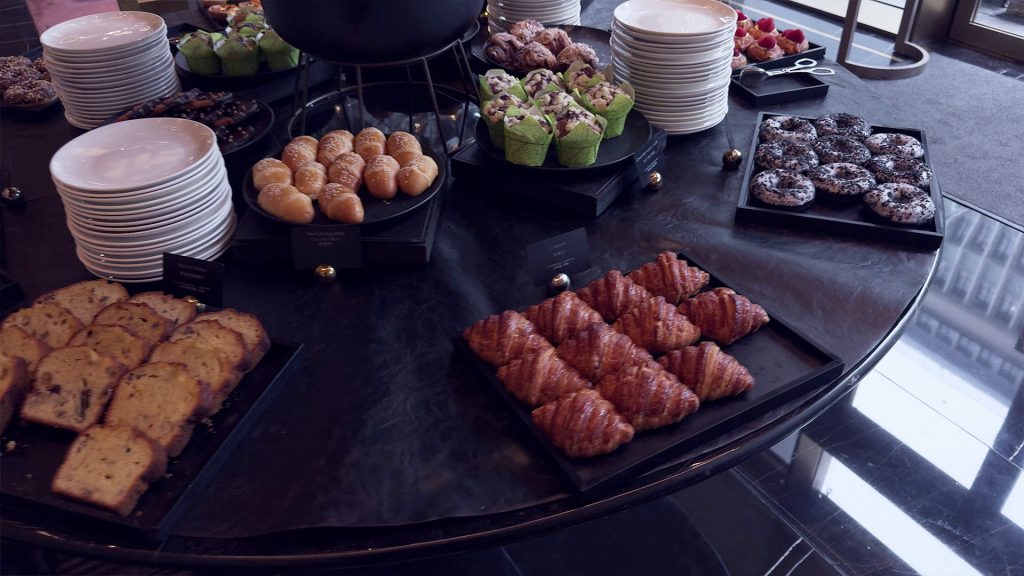
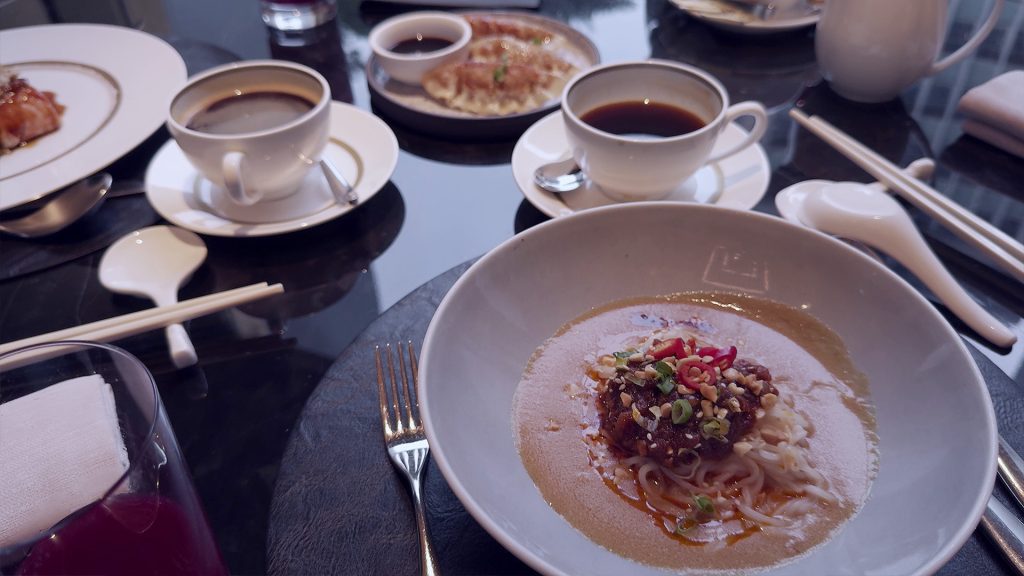
We didn’t explore many of The Murray’s other facilities, but we did make the most of the breakfast, which arguably turned out to be one of the strong points of the stay. Especially if you’re in Hong Kong for just a few days and won’t have time to explore all of the local food spots, it’s nice to know that breakfast here includes some well-executed local dishes alongside the usual international spread.
The rooftop bar, skyline views, and central location add to the appeal. And despite its five-star rating, The Murray is actually one of the more affordable luxury hotels in Hong Kong, especially when compared to some of its waterfront competitors.
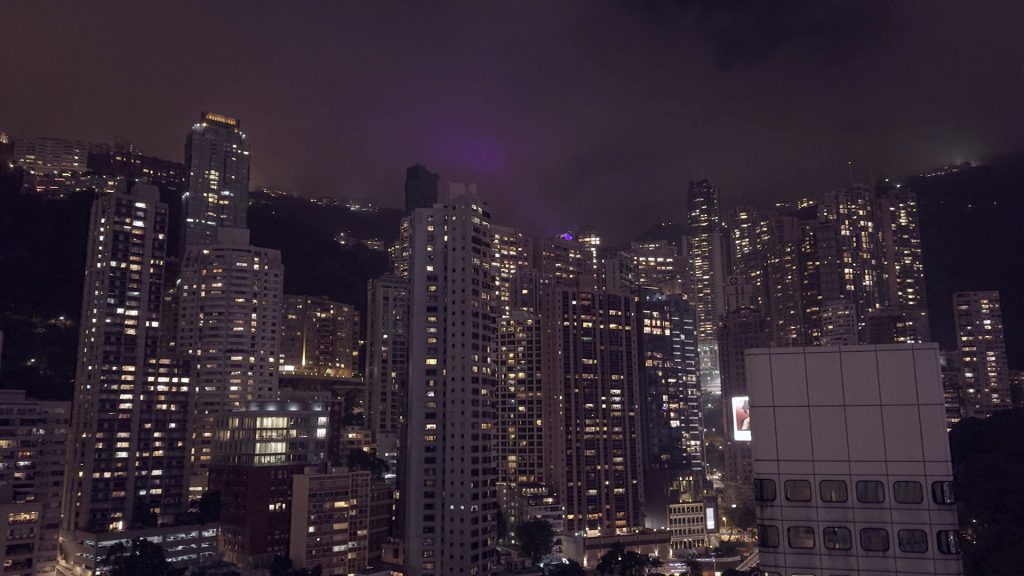
If it fits your budget, The Murray is absolutely worth considering for the architecture, the location, and the quiet sense of calm it offers in one of Asia’s busiest cities.
Cathay Pacific Business Class Review: The Verdict
Should You Fly Cathay Pacific Business Class on the 777-300ER (FRA to HKG)?
- Pros:
- 1-2-1 reverse herringbone configuration with direct aisle access for everyone
- Outstanding meal service—one of the best in-flight vegetarian mains I’ve had on any airline
- Free WiFi for business class passengers
- Reusable Bamford amenity kit with some genuinely useful extras (mouthwash, pillow mist, cooling gel)
- Solid lie-flat bed with mattress pad, thick blanket, and a sense of space uncommon for a non-suite seat
- Warm, efficient crew with a distinctly Hong Kongese character
- Cons:
- The seat and IFE hardware both show their age; visible wear on some panels; screens feel behind the curve
- Cabin temperature runs warm; bring a personal fan if you sleep hot
- Bathrooms were not particularly well maintained throughout the flight
- The Frankfurt Priority Lounge setup (shared, often crowded) is the weakest part of the journey
There’s no question that this cabin is showing its age. The seat works—it’s roomy, it lies flat, and it has decent storage—but the entire product feels like it belongs to a different era of premium travel. The screen is outdated, and wear is visible in a few places. With Cathay slowly rolling out its new Aria Suite, this older generation clearly isn’t the star of the show anymore.
But that doesn’t mean it’s a bad experience. The seat is still comfortable, the service is polished, and the meal service—particularly that cauliflower and chickpea stew—is genuinely memorable. Even the old product can comfortably compete on the route between Europe and Hong Kong.
Cathay is clearly in a transitional phase, balancing the deployment of a brand-new hard product while maintaining service levels across its existing fleet. This flight showed both sides of that balance: a cabin that feels past its prime, paired with a crew and soft product that still keeps the overall experience competitive.
As for the crew, the service was warm and efficient. Perhaps a little more reserved than what you might expect from some other Asian carriers, but certainly more attentive and welcoming than what you’d typically find on many European airlines. Part of that is that Cathay feels like it has an identity. It is metropolitan with a distinguishable Hong Kongese charm that makes it stand out in its own way.
So, would I fly Cathay Pacific business class again, even in this older cabin? Absolutely. As long as expectations are set appropriately, the experience still holds up well. And with the Aria Suite rollout on the horizon, the future of Cathay’s premium product looks promising and is something to be excited for.
Related: More Cathay Pacific and Hong Kong Content
- Related airline review: Asiana Airlines A350 Business Class Review (FRA – ICN) – another Star Alliance competitor on the same Frankfurt – Asia corridor.
- Related gear guide: Airalo Asialink eSIM for South Korea: Tested Review – the exact same multi-country eSIM I used on this Asia trip.
Pros & Cons
- 1-2-1 reverse herringbone configuration with direct aisle access for every passenger
- Excellent meal service with standout vegetarian options and all-day dining menu
- Free WiFi, comfortable lie-flat bed with mattress pad, and premium Bamford amenity kit
- Dated IFE screens and visible cabin wear throughout the aircraft
- Uncomfortably warm cabin temperatures make sleeping difficult without a personal fan
- Disappointing Priority Lounge at Frankfurt is shared and often overcrowded
Cathay Pacific Business Class: FAQ
Quick answers to common questions about Cathay Pacific’s long-haul business class on the 777-300ER, and how it compares to the new Aria Suite.
Is Cathay Pacific business class worth it on the 777-300ER?
Yes, with the right expectations. The 777-300ER is showing its age: the IFE screen is small, panels show wear, and the seat is a generation behind the new Aria Suite. But the seat is still a fully lie-flat reverse herringbone with direct aisle access, the meal service (especially the vegetarian mains) is excellent, the Bamford amenity kit is reusable and well-stocked, and WiFi is now free in business class. If you can get it at a reasonable price — especially as part of a connecting itinerary — it’s still a competitive premium product.
What is the new Cathay Aria Suite?
The Aria Suite is Cathay Pacific’s next-generation business class seat, currently being rolled out across the long-haul fleet. It features a fully enclosed suite with sliding doors for privacy, a 24-inch 4K screen, and a redesigned seat platform. The 777-300ER cabin shown in this review is a generation behind the Aria Suite, and Cathay is in a transitional phase as the new hard product is gradually deployed across the fleet.
What is the seat configuration on the Cathay 777-300ER in business class?
The Cathay Pacific 777-300ER features a 1-2-1 reverse herringbone configuration in business class. Every seat has direct aisle access. Window seats face the window for privacy; middle seats are angled toward each other but separated by a wall — not the “honeymoon seat” layout you find on some other airlines.
Does Cathay Pacific business class include free WiFi?
Yes, on Cathay’s long-haul and regional fleet. Business class passengers get free WiFi on all Cathay flights in the current series. The connection is stable enough for email, browsing, and even some streaming on most of the flight. There is a known workaround for the captive-portal login that I cover in a YouTube short linked in the article.
What amenity kit does Cathay Pacific business class use?
Cathay Pacific business class uses a Bamford-branded amenity kit. The bag itself is a compact leather-optic design with a magnetic closure — genuinely reusable as an everyday organiser. Contents include toothbrush, toothpaste, eye mask, earplugs, lip balm, mouthwash, pillow mist, and a cooling body gel.
Is Cathay Pacific part of an airline alliance?
Yes. Cathay Pacific is a member of the Oneworld alliance, alongside American Airlines, British Airways, Japan Airlines, Qantas, Finnair, and others. Oneworld status and miles can be used and earned across the alliance.
How do I get from Hong Kong Airport (HKG) to central Hong Kong?
The fastest option is the Airport Express train from HKG to Hong Kong Station in the central district. The ride takes about 24 minutes, with trains running every 10–12 minutes. From Hong Kong Station, you can connect to the MTR subway or take a taxi to your hotel. The Murray Hotel (covered above) provides a shuttle from Hong Kong Station for guests.
My Travel Gear on this Flight
- The North Face Suitcase
- The North Face Backpack
- Victorinox Carry On
- Phone/Camera
- Bluetooth Headphone Adapter with Aeroplane Plug
- Travel Power Adapter
- Travel Portable Fan
- Travel Portable Fan (International)
- Recording SSD Enclosure
- Travel SSD
What’s Next in this Series?
After a few days in Hong Kong—and a few more excellent meals—it’s time to head back to the airport and continue this trip, this time heading to Japan. In the next Cathay Pacific business class review in this series, we’ll take a closer look at the regional business class product as we fly from Hong Kong to Osaka on the 777-300ER.
So, if you’re curious how Cathay performs on shorter routes—or want to follow along with the rest of this journey—make sure to subscribe to our YouTube channel and return to the blog so you don’t miss what’s coming next.
- Share this post with someone who’s planning a trip to Hong Kong (or anywhere in Asia)!
- Bookmark MidAirTimes.com for more airline reviews, travel tips, and local guides.
- Leave a Comment: Have you flown Cathay Pacific business class recently? How was your experience, especially if you’ve been lucky enough to try the new Aria Suite?
Thank you for reading, and see you in the next post!
Disclaimer: Some links in this post are affiliate links, meaning we may earn a small commission at no extra cost to you if you purchase through them. This helps support the blog so we can continue to provide quality travel content. Thank you for your support!
Leave a Reply